Simulating the Wetting of Mesh Structures for Gas Diffusion Electrodes with a Phase-Field Method
 Wagner,Alexander_Simulating the Wetting of Mesh Structures for Gas Diffusion Electrodes with a Phase-Field Method
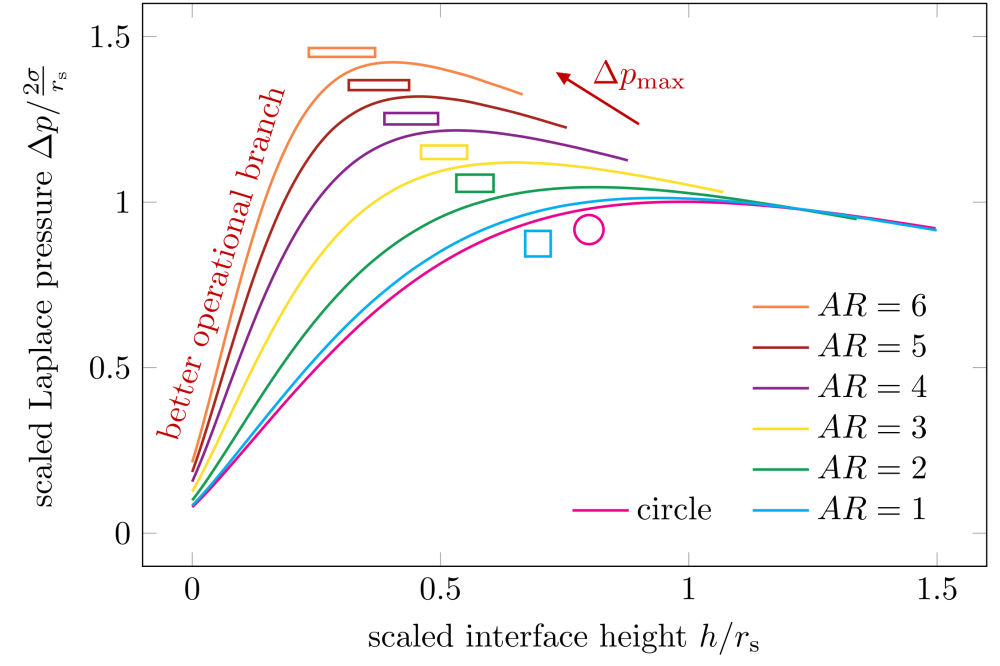
The aspect ratio of the single openings influences the pressure range over which a stable gas-liquid boundary can be maintained.
 Wagner,Alexander_Simulating the Wetting of Mesh Structures for Gas Diffusion Electrodes with a Phase-Field Method1
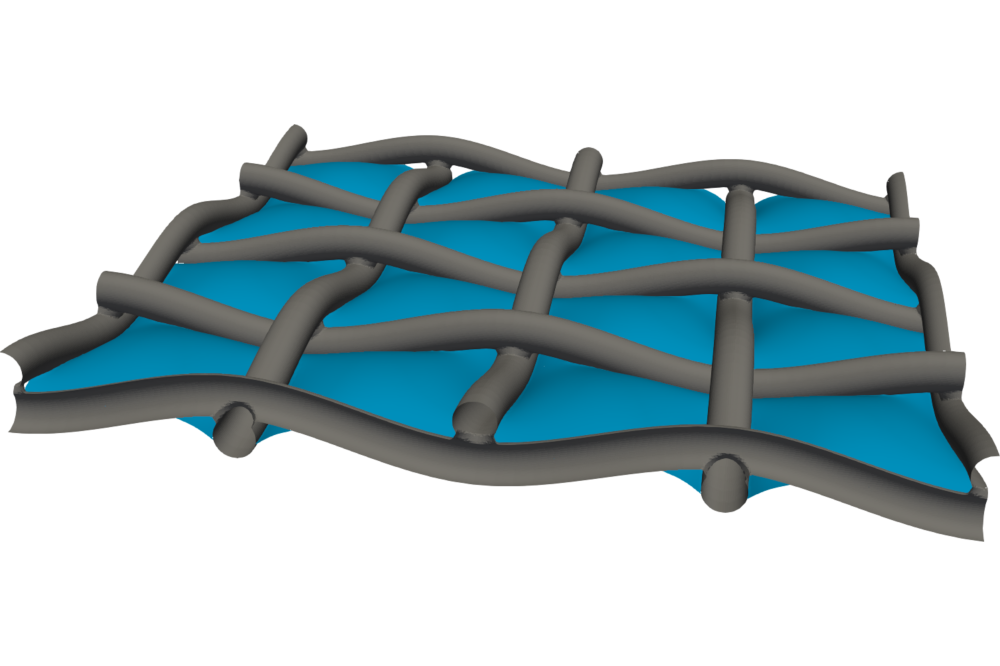
Simulation of a gas-liquid interface sitting inside a woven gas diffusion electrode.
Introduction
Electrochemical synthesis, which produces valuable chemicals using electrical energy rather than fossil fuels, is gaining importance for a more sustainable chemical industry. A central, promising component in many such processes is the gas diffusion electrode: a porous structure that maintains a stable boundary between a liquid electrolyte and a reactive gas, such as carbon dioxide, inside the electrode. This boundary provides a short diffusion path and a large contact area for the chemical reaction. While this concept works well with aqueous electrolytes, applying it to organic solvents, as required for many industrially relevant reactions, remains an open challenge. Organic solvents have much lower surface tension than water, causing conventional gas diffusion electrodes to flood and lose their gas-liquid separation. A research project funded by the BMFTR addressed this by developing structured metallic mesh electrodes in which the gas-liquid boundary was stabilized by controlling the pressure difference across the mesh. To design such electrodes, a detailed understanding of how mesh geometry, surface wetting properties, and operating conditions influenced boundary stability was needed. Physical experiments alone could not efficiently explore this large parameter space, so computer simulation was used as the main tool. These simulations were computationally demanding: They involved complex three-dimensional mesh geometries, very fine spatial resolution to resolve thin fluid films and contact lines at the wire surfaces, and thousands of time steps per run. A single simulation required up to 24 hours on 96 processor cores working in parallel, making access to a high-performance computer (HPC) essential.
Methods
The simulations used a phase-field method: a mathematical framework that describes the gas-liquid interface as a smooth transition zone rather than a sharp line. This method enabled an accurate description of the wetting behavior at the three-phase contact line, where gas, liquid, and solid wire surfaces meet simultaneously, which is difficult to handle with other simulation approaches. The equations governing fluid flow and the evolution of the gas-liquid interface were solved numerically in three dimensions using the open-source software OpenFOAM. Grid refinement and time-step studies were carried out to verify numerical accuracy. For the simple test case of bubble formation at a single circular opening in a flat plate, simulated bubble shapes and corresponding pressure differences across the gas-liquid interface were compared against analytical solutions, serving as a validation baseline before moving to more complex geometries.
Results
The project produced a validated simulation environment for predicting gas-liquid boundary behavior in metallic mesh structures. The main tasks and their outcomes were:
- Validation: Numerical results were compared against analytical predictions and optical measurements from an experimental test stand, confirming that the method worked correctly.
- Orifice shape study: Circular, square, and elongated rectangular mesh openings were compared. The opening shape has a significant influence on the pressure range over which a stable gas-liquid boundary can be maintained, which is a useful finding for electrode design.
- Parameter studies: Opening size, wetting angle, and applied pressure difference were systematically varied, producing a first map linking geometry and operating conditions to interface stability.
- Complex mesh geometries: Three-dimensional simulations of realistic woven mesh structures were carried out, showing how neighboring wires jointly determine boundary stability.
- Dynamic conditions: The effects of liquid cross-flow and pulsating pressure were investigated, bringing the simulations closer to realistic operating conditions.
Discussion
The results showed that phase-field simulation in OpenFOAM was well suited for studying gas diffusion electrode behavior. The finding that the opening shape strongly affects the stable pressure range gave experimental partners clear design guidance that experiments alone could not easily provide. The simulation framework developed here now serves as the basis for a follow-up project with broader scope: additional organic electrolyte systems and more complex mesh types are being studied, chemical species transport and electrochemical reactions are being added to the solver, and automated optimization is being used to search for better mesh designs for specific target reactions. Without continued HPC access, running the large number of simulations required for this work would not be feasible.