
Scale-Resolving Computational Study of Flow and Heat Transfer Dynamics in Fuel Cell Cooling Systems
 Louis Krüger_Scale-Resolving Computational Study of Flow and Heat Transfer Dynamics in Fuel Cell Cooling Systems_Figure1
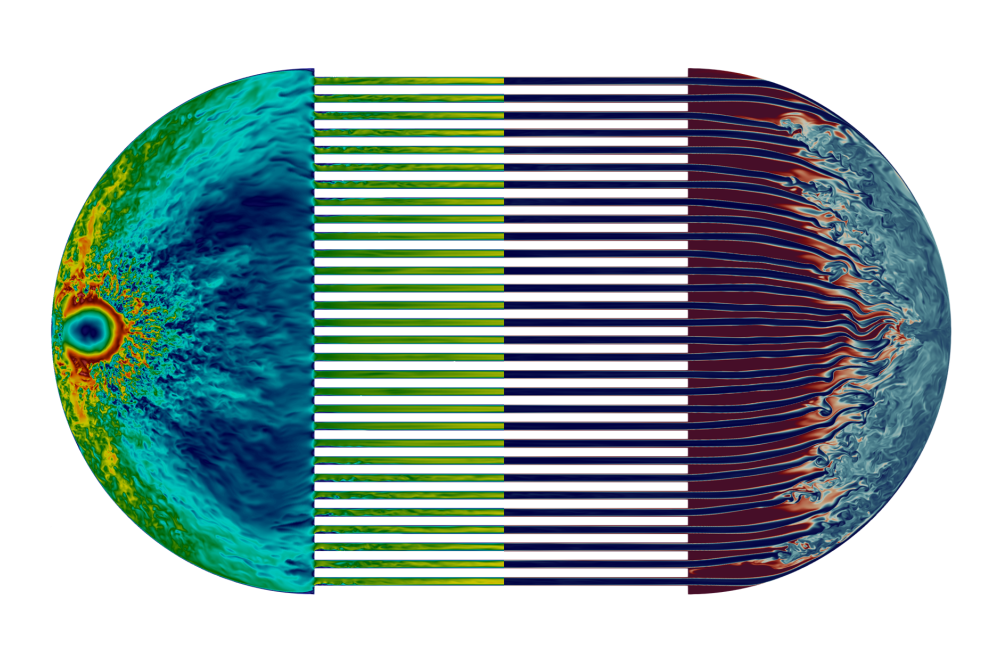
Figure 1: Instantaneous velocity field (left) and temperature field (right) in the bipolar plate, showing flow structures and the corresponding thermal field in the distribution and confluence zones.
 Louis Krüger_Scale-Resolving Computational Study of Flow and Heat Transfer Dynamics in Fuel Cell Cooling Systems_Figure2
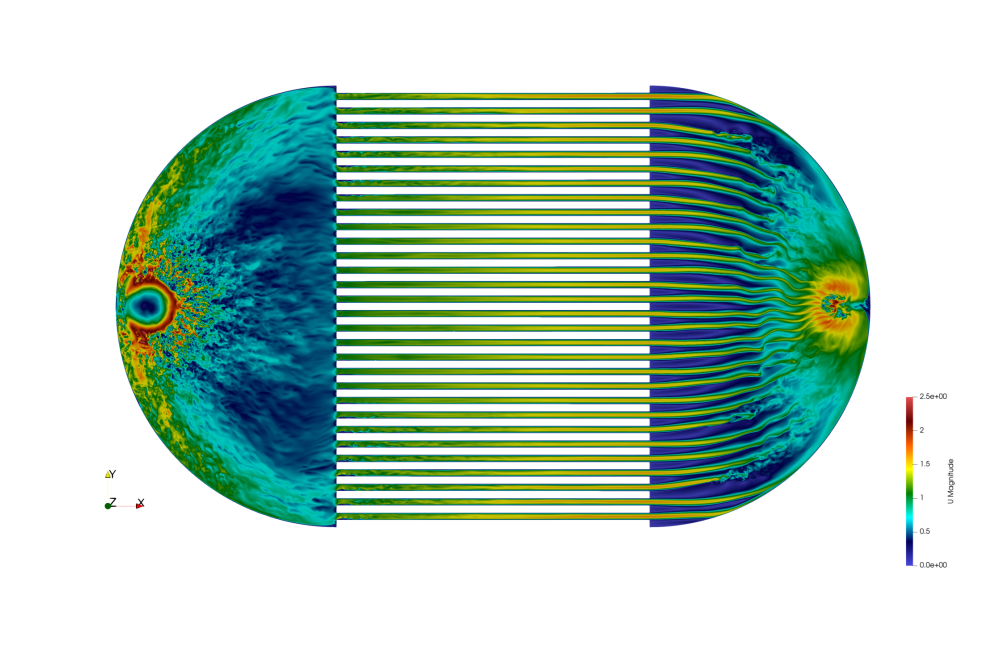
Figure 2: Velocity magnitude obtained by LES in the bipolar plate geometry, illustrating jet impingement, channel-wise flow distribution and turbulent structures in the distribution and confluence zone.
Introduction
Hydrogen fuel cells are considered a key technology for future sustainable energy systems, especially in the mobility sector. Their efficiency and lifetime strongly depend on the ability to keep the fuel cell stack within a suitable temperature range. For this reason, the cooling system is a central component of modern fuel cell designs. Inside the cooling channels complex flow phenomena occur, including jet interaction, flow seperation, relaminarisation and transition. These effects strongly influence heat transfer and are difficult to predict with conventional numerical approaches. This project involves studying the flow dynamics and thermal behaviour of a generic fuel cell cooling plate using numerical simulations on the HPC cluster. The goal is to evaluate and further develop advanced turbulence models that can resolve relevant flow structures at reasonable computational cost. This will help to improve modelling accuracy and contribute to the design of more efficient cooling systems for future hydrogen technologies.
Methods
The simulations in this project are performed using the open-source software OpenFOAM, which allows solving the governing flow and heat transfer equations for complex geometries. The computational domain represents a generic bipolar plate featuring multiple parallel cooling channels, thereby reproducing the geometric characteristics of fuel cell cooling systems. In order to investigate different flow regimes, we apply a hierarchical simulation strategy, starting from steady simulations and then moving towards unsteady and scale-resolving approaches. The turbulence modelling strategy ranges from conventional Reynolds-Averaged approaches to advanced hybrid formulations that adaptively resolve unsteady flow structures depending on the local conditions and is further complemented by high-fidelity Large-Eddy Simulations. The mesh resolution is adjusted to each modelling approach and is generally refined in regions where complex flow structures or heat transfer effects occur
Results
The simulations quantify the flow distribution and thermal behaviour of the reference bipolar plate across the defined operating conditions and demonstrate pronounced unsteady flow dynamics in several characteristic regions of the geometry. The steady simulations provided fundamental insight into the macroscopic flow topology within the bipolar plate and were subsequently used to initialise the unsteady simulations. Furthermore, the hybrid LES/RANS approach was successfully applied and has demonstrated its capability to resolve characteristic flow features such as jet impingement and flow separation. For reduced grid sizes, the model provides results that are consistent with large-scale reference simulations. Comparisons with Large-Eddy Simulations show that the hybrid approach significantly reduces computational effort while retaining the essential predictive accuracy. Overall, the numerical studies demonstrate the feasibility of the modelling strategy and provide a solid basis for the ongoing development.
Discussion
The numerical investigations demonstrate that scale-resolving turbulence modelling is essential for predicting the dominant unsteady mechanisms in the cooling channels of the reference bipolar plate. In particular, the hybrid eddy-resolving approach combines physical fidelity with significantly reduced computational cost compared to Large-Eddy Simulations, while the results still remain consistent with high-resolution reference data. Building on these findings, the methodological focus will remain on advanced hybrid turbulence closures for assessing fuel cell cooling performance, with future work concentrating on a more consistent coupling of flow and heat transfer to enhance the prediction of temperature fields. In addition, comparisons with complementary modelling strategies and refined grid strategies will further support the development of reliable and computationally efficient simulation tools for future optimisation of fuel cell cooling systems.