
CASSCF Study for Magnetic Properties of Transition Metal Doped Tin Clusters
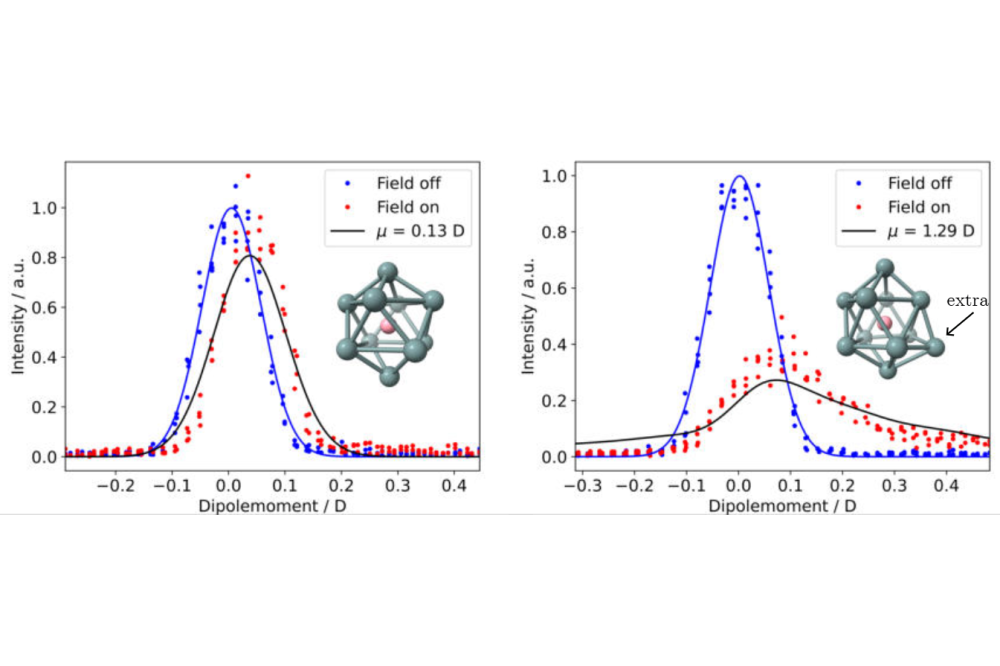 Jannik Mehmel_CASSCF study for magnetic properties of transition metal doped tin clusters_Figure1
Figure 1: Experimental electric beam profiles of CoSn10 (left) and CoSn11 (right) at 16K nozzle temperature and 24kV deflection voltage. The quantum chemical structures are found by global optimization and the electric beam profile is simulated by using the dipole moment and the moments of inertia of the structure to solve the Euler equations in an electric field (black line). The structure motive of CoSn10 is also present in CoSn11 in which the extra tin atom just sits at the side of the Sn10 cage, leading to a great increase in the dipole moment of the cluster.
Introduction
Molecular beam experiments on metal clusters enable to investigate their physical properties in a vacuum without any interactions with a solvent or matrix. Deflection of the cluster beam by inhomogeneous electric and magnetic fields yields insight into their geometric and electronic structure. In the case of metal clusters, their structure is not known beforehand and can not be guessed with chemical intuition. In the case of roughly a dozen metal atoms there exist a huge amount of possibilities to arrange the atoms with numerous local minima on the potential energy surface.
Methods
In order to find the global minimum structure of metal clusters many quantum chemical calculations have to be carried out for different geometries. Each structure can be used to solve the Euler equations of rotation in the electric field numerically thousands of times with different initial conditions in order to compare the structure with the experimental data. This is done by a self written parallel Julia code on the HPC cluster. If a structure with low energy is found that describes the deflection by an inhomogeneous electric field, magnetic deflection of this cluster can be used to gain greater insight into its electronic structure. The magnetic properties of the clusters can be understood by CASSCF calculations which can become very computationally costly, especially in terms of runtime and memory requirement, that can only be tackled by HPC. In both cases, the quantum chemistry program ORCA is used. The project was mainly used to study cobalt-doped tin clusters.
Results
The cluster CoSn10 shows a surprisingly high intensity in the mass spectrum, which is in the same order as CoSn12. Typically, in other first row transition metal doped tin clusters, the MSn12 cluster is the most intense doped cluster, which highlights that CoSn10 might be specifically stable. Figure 1 shows an example of the seemingly high stability of CoSn10. The blue data points show how the spatially resolved cluster beam intensity looks like with no electric field applied. The red data points show how this spatial intensity distribution changes if the electric field is turned on. On the left side, CoSn10 only shows a minor broadening of the field-on data points compared to the field-off data points, indicating a structure with a small permanent electric dipole moment. The global optimization of the cluster geometry resulted in the structure shown as an inset in the plot. It has only a slight dipole moment with 0.13 D. The structure with its moments of inertia and dipole moment can be used to simulate the rotational dynamics of a the cluster in an electric field by solving the Euler equations. For that, the system of differential equations is solved 5000 times with different initial conditions to generate a dipole moment distribution function which can be compared to the experimental data as shown as a black line. This procedure can also be carried out for CoSn11, which is shown on the right in figure 1. Not only does the structure describe the experimental data quite well, the structure shows the same CoSn10 base structure with just one additional tin atom on the side. This additional tin atom is the reason for the now much greater dipole moment of 1.29 D of CoSn11. Further structural isomers which are composed of this CoSn10 base structure have been found by global optimization. This underlines that the CoSn10 structure is a prominent structural motive in cobalt doped tin-clusters. These structures form the basis to carry out quantum chemical calculations (CASSCF) to explain the origin of the magnetic deflection behavior. Preliminary calculations of the magnetic properties of these structures show quite good agreement with the measurements of the magnetic properties.
Discussion
The identified structural isomers for cobalt doped tin clusters agree reasonably well with the electric deflection experiments and can be used to discuss the magnetic deflection experiments. Apart from some early success in describing the magnetic properties quantum-chemically, the experimental results still need more work in order to decrease the uncertainty of the measured data points. Furthermore, it is not only time consuming but also challenging to analyze the electronic structure of these clusters to explain the observed magnetism in detail. This project basically laid the foundation for future CASSCF calculations by finding possible geometric structures for different cluster sizes.