
Parametric Study on Determination of Load-Bearing Capacity of Dry-stacked Masonry Wall under Cyclic Loading II
 Danièle Waldmann-Diederich_Parametric Study on Determination of Load-Bearing Capacity of Dry-stacked Masonry Wall under Cyclic Loading II
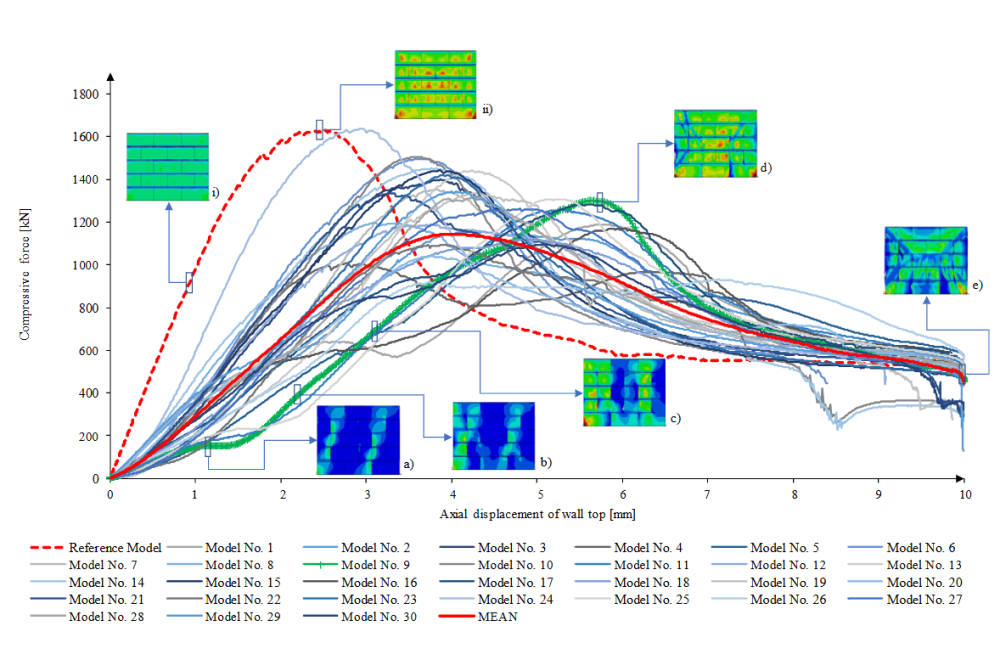
Figure 1: Influence of the unit height variation on the compression capacity of wall 3 × 5.
Introduction
In the research areaof circular building design, design concepts for sustainable masonry are being implemented using both renewable materials and reusable building blocks. When constructing a masonry wall, the effort and costs are mainly associated with the brickwork, especially with the mortar. When the building is demolished, the materials used can usually only be recycled in exceptional cases. Dry-stacked masonry (DSM) can be an alternative here to enable reusability. In this case, bricks with an interlocking configuration are simply stacked into each other, without the need for mortar in the horizontal joints. The effort required to construct the walls is thus considerably reduced in terms of costs and labour. However, the most important advantage becomes apparent when the wall is demolished. The masonry walls can be easily removed by demounting the individual blocks. In the case of a suitable or removable plaster layer, undamaged blocks can then be reused.
Methods
DSM wall systems have different geometric component shapes and interlocking configurations compared to conventional unreinforced masonry walls (URM). To understand their structural behaviour, it is therefore necessary to investigate the effects of various design parameters (e.g. compressive strength of the components, composite system, contact area, non-linear behaviour of the material). This can be done mainly by examining experimentally validated non-linear finite element models of DSM walls. The behaviour of dry masonry walls has been investigated in extensive and diverse research projects in recent decades. The numerous investigations show that under seismic loading, for a given masonry unit shape, an additional strengthening method such as reinforcement or even prestressing is required. The load-bearing capacity under vertical loading has already been carried out and analysed for DSM in previous projects. The present research project will not only investigate the load-bearing capacity, but also the deformation behaviour under horizontal dynamic loading in the wall plane and perpendicular to the wall plane. The aim is to optimise the configuration of the interlocking joints for horizontal load transfer. The research project includes the following steps: Experimental investigation of the load-bearing and deformation capacity of dry masonry walls under static and cyclic loading. Numerical investigations considering the real material properties and contact conditions using FE models of dry masonry walls under static and cyclic loading. Numerical investigation of the influence of the different input parameters, especially the configuration of the interlocking joints and the seismic load, on the horizontal load-bearing capacity of dry masonry walls. Assessment of the structural reliability of the safety factor for DSM walls under seismic loading. In addition, the development of an analytical model for the design of DSM walls is aimed for. Firstly, in order to be able to apply the shear load, it is essential to understand their structural behaviour under axial compression. However, previous projects have mainly focused on the linear behaviour of the DSM wall, in particular the load percolation taking into account the unit height variation. Therefore, in this study, the investigation starts with a parametric study for DSM wall subjected by compression. The study is carried out using probabilistic analysis based on a non-linear finite element model, which is calibrated and validated on the basis of the experimental results. The finite element model of a masonry wall is created in Abaqus using a simple masonry unit geometry. For the parameter studies, different sets of walls are created using Python in combination with the model in Abaqus, which are then run on HPCL.
Results
The investigations have demonstrated that variations in masonry unit height influence the load-bearing behaviour of DSM walls. Deviations in height generate local gaps that induce tilting and seating effects, alter load distribution and progressively improve contact areas under increasing loading. The second dominant parameter is wall slenderness: increasing slenderness significantly reduces both the mean and the characteristic compressive capacity due to second-order effects. The resulting capacity reduction factor in slenderness is highly nonlinear, particularly when geometric imperfections are pronounced. Models that neglect the interaction between height imperfections and slenderness substantially predict compressive strength incorrectly. Surface roughness has only a minor influence on mean capacity, but it increases dispersion of results and prediction uncertainty. Despite height imperfections, load transfer at peak load resembles that of ideally aligned walls, while failure is governed by local masonry fracture and contact failure. Based on these findings, a design model for concentric axial loading was developed as a function of wall slenderness. This model incorporates a partial safety factor to reflect statistical uncertainty and a nonlinear factor to account for geometric variability. In the first study phase, 218 finite element (FE) simulations were conducted to assess the effects of slenderness and roughness. The second phase involved performing 500 nonlinear FE simulations, each including up to 300,000 deformable elements, using Abaqus/Explicit on HPC systems, to investigate the combined effects of slenderness and eccentricity. The results show that loading eccentricity has a significant impact on capacity. For reference models with perfect contact, an eccentricity ratio of e/t = 0.40 reduces compressive strength by up to 50% compared to that of DSM wall under axial loading. This reduction persists across all slenderness levels when stochastic height imperfections are included. Eccentric loading induces out-of-plane bending, uplift of one face shell and elevated tensile and shear stresses. This leads to failure that is governed by tensile cracking, diagonal compressive damage and instability. While initial load transfer occurs through discrete contact zones, seating and tilting progressively form more distributed load paths. Across all stochastic realisations, compressive strength decreases almost linearly for the investigate range between 0.15 and 0.40. For each slenderness–eccentricity combination, strength distributions were probabilistically evaluated. Despite a unit height coefficient of variation (CoV) of only 0.3%, wall strength exhibits a CoV of 10–13%, highlighting the strong amplification of geometric imperfections. Normal distributions best fit the FE results and provide slightly conservative characteristic values. A reduction factor, ϕ, dependent on slenderness and eccentricity, was derived and integrated into a design formulation analogous to DIN EN 1996-1-1. The proposed approach predicts characteristic capacities that are 40–76% lower than those of simplified models without distribution of height imperfection. Validation against experiments in the literatures eccentrically loaded DSM walls confirms the method's accuracy and consistency when combined with an appropriate partial safety factor. In summary, variability in unit height, wall slenderness and loading eccentricity interact strongly and must be considered simultaneously. Probabilistic modelling is essential in order to capture these nonlinear effects, and the proposed stochastic finite element (FE) framework provides a robust basis for the reliable prediction of strength and the design of DSM walls under eccentric compression.
Discussion
For different geometric and interlocking configurations and boundary conditions, several sets of stochastic analyses under shear loading as a result of the finite element modelling should be carried out next in the following project 3212 (Investigation of dynamic response and shear behaviour of DSM wall with interlocking system subjected to seismic loading).