
Quantum Chemical Investigation of Polyoxometalates
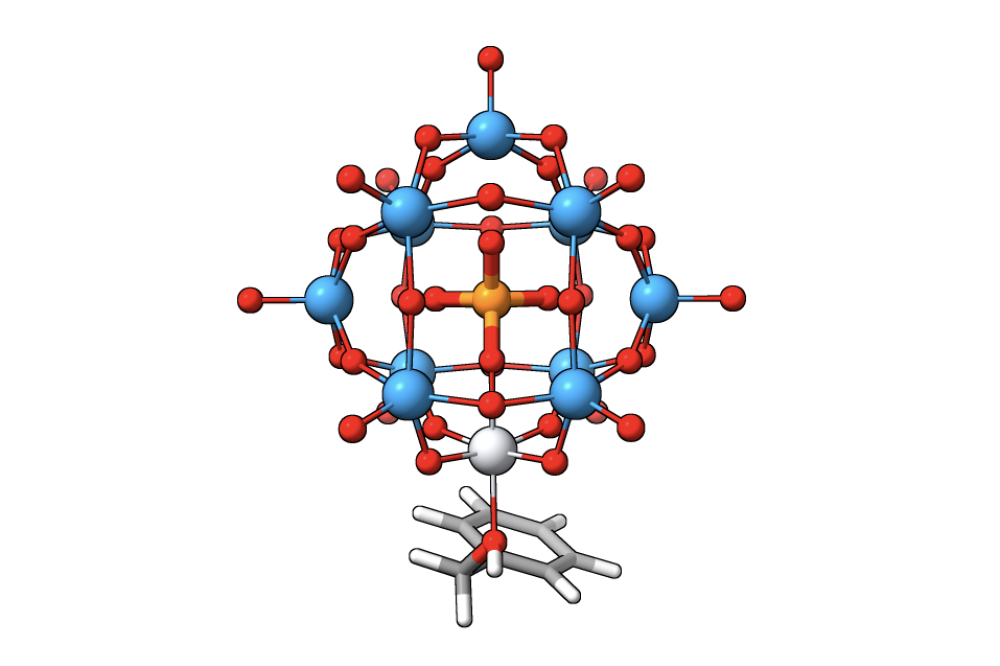 Galeas_Dayana_Quantum Chemical Investigation of Polyoxometalates_Fig1
Figure 1: Keggin-type polyoxometalate [PW11O39Ti(OH-CH2-Ph)]-3
Dayana M. Galeas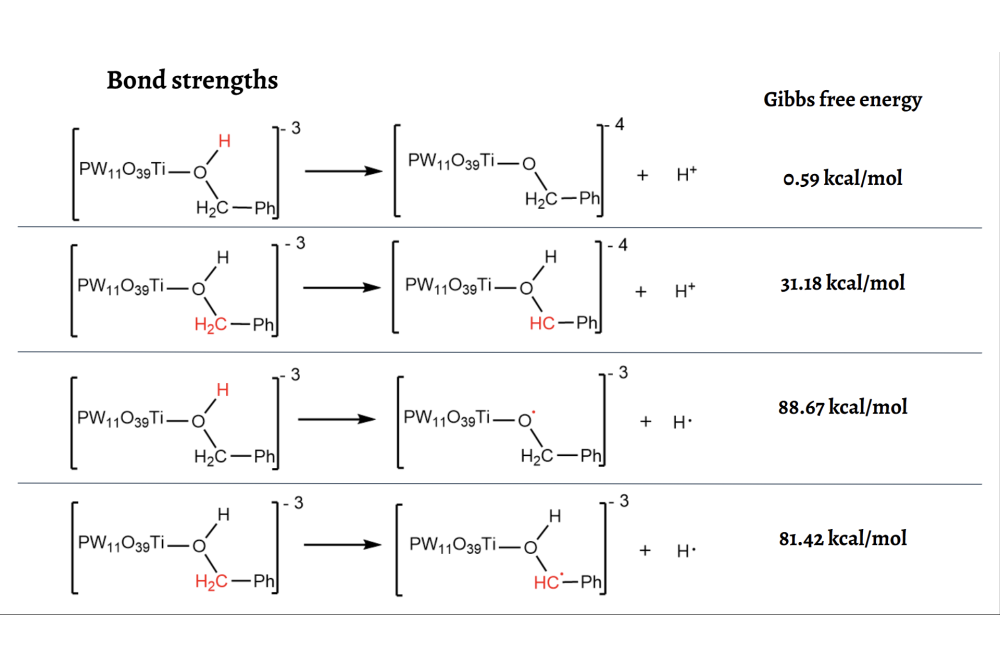 Galeas_Dayana_Quantum Chemical Investigation of Polyoxometalates_Scheme1
Scheme 1: Analysis of homolytic and heterolytic cleavage via bond strengths on O-H
and alpha C-H
 Galeas_Dayana_Quantum Chemical Investigation of Polyoxometalates_Scheme2
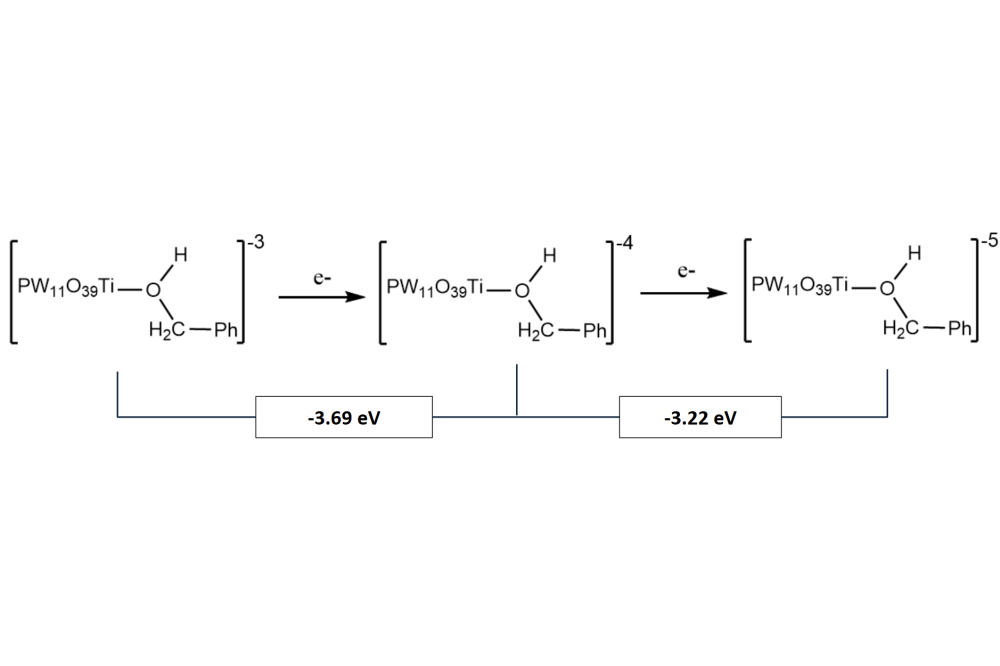
Scheme 2: Reduction potentials for single and double reductions
Dayana M. Galeas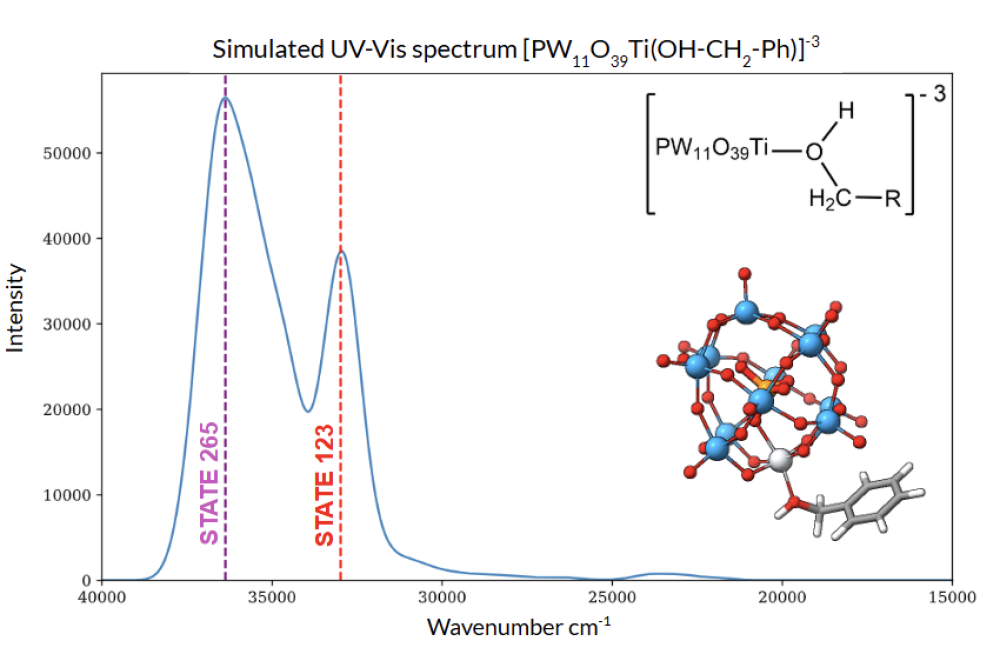 Galeas_Dayana_Quantum Chemical Investigation of Polyoxometalates_Fig2
Figure 2: Simulated UV-Vis spectrum [PW11O39Ti(OH-CH2-Ph)]-3
Dayana M. Galeas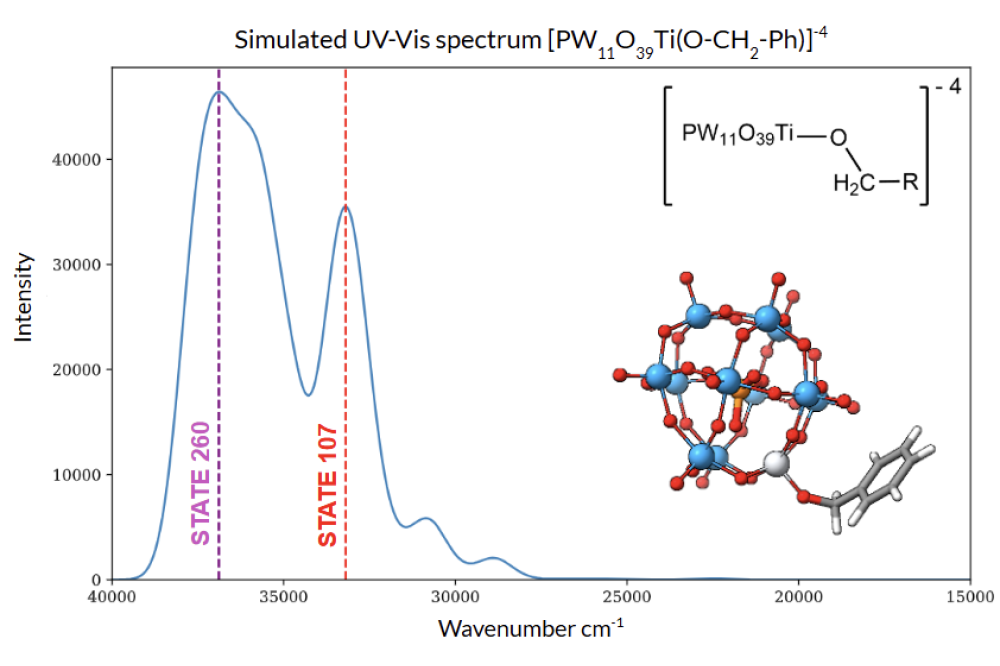 Galeas_Dayana_Quantum Chemical Investigation of Polyoxometalates_Fig3
Figure 3: Simulated UV-Vis spectrum [PW11O39Ti(O-CH2-Ph)]-4
Dayana M. Galeas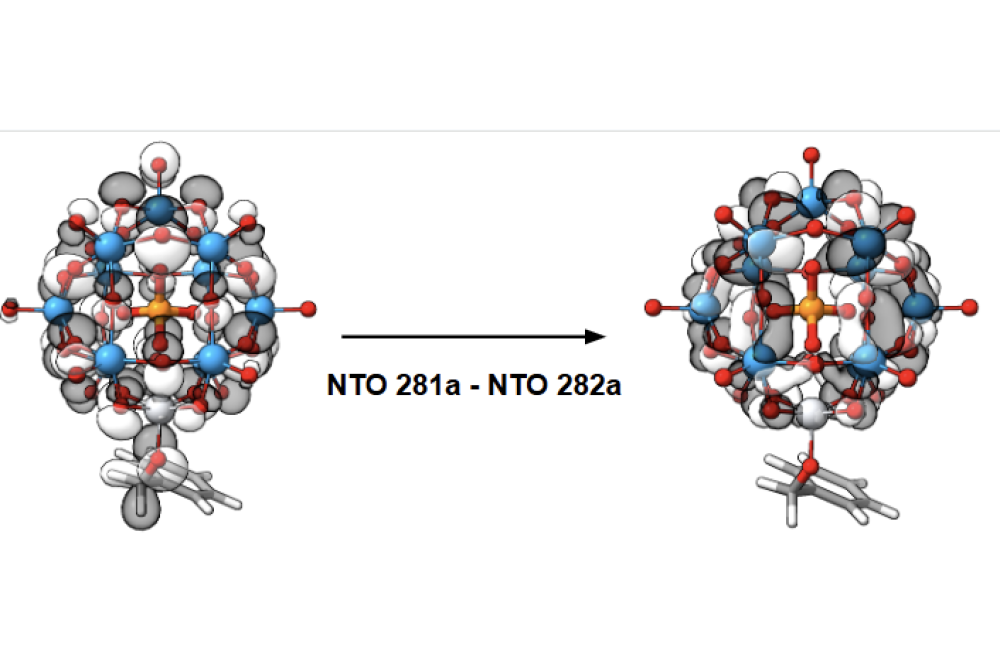 Galeas_Dayana_Quantum Chemical Investigation of Polyoxometalates_Fig4
Figure 4: Natural transition orbital analysis
Dayana M. GaleasIntroduction
Polyoxometalates (POMs) are well-defined chemical entities with promising catalytic properties. They consist of transition metal ions linked by oxygen bridges. In water, their exact speciation in terms of the formation of hydroxy groups or strong hydrogen bonds with the solvent is difficult to determine. In this project, we study the speciation and the influence on observable properties like UV-vis spectra and redox potentials using quantum chemical calculations. Proton-coupled electron transfer (PCET) studies were focussed on Keggin-type [PW12O40]-3 and Lindqvist-type [W6O19]-2 polyoxotungstates (POT). Both functionalized at the surface with zinc or titanium, since these metals are capable of forming reducible metal oxides that can act as PCET agents.
Methods
All the calculations are driven according to experimental conditions in order to closely simulate their electronic attributes. Experimental data served as a benchmark for the theoretically reproduced spectra. Methods based on density functional theory (DFT) for the geometry optimizations were utilized at the level of r2scan-3c and CPCM as a solvation model in acetonitrile. Similarly, time dependent density functional theory (TD-DFT) revealed the ultraviolet and visible regions of the electromagnetic spectrum. The reduction potentials arise from the single point energies of each species after electron additions.
Results
Both experimentally and at the theory level, the Keggin-type polyoxotungstates showcased better properties. Therefore, the chosen POM for the studies was the titanium functionalized Keggin polyoxotungstate [PW11TiO40]-3 coupled with benzoic acid (Figure 1). This study investigated the deprotonation of the structure occurring at the alcohol O-H or the alpha carbon in the C-H bond. Besides, we analyze the possibility of occurring via radical homolytic cleavage. The bond strengths of these reactions are displayed in Scheme 1. The reduction potentials of the structure are also displayed in Scheme 2. As the energy barrier for the heterolytic cleavage in the alcohol is the lowest one, the deprotonation is assumed as the mechanism. The UV-Vis spectra of [PW11O39Ti(O-CH2-Ph)]-4 and [PW11O39Ti(O-CH2-Ph)]-4 are reproducing exactly the experimental results with great accuracy (Figure 2 and 3). From the spectra, the analysis of the natural transition orbitals is displayed in Figure 4.
Discussion
From the TD-DFT calculations, it is found that the electronic transitions are dominantly HOMO to LUMO transitions with π→π∗ character. The absorption spectrum contains a low and a high energy transition. The high energy transition is attributed to the POM while the low energy transition is a charge transfer transition from the alcohol ligand to the POM. The bond dissociation enthalpies of O–H in the Ti functionalized POTs are significantly lower than for the C-H. Consequently, deprotonation of the alcohol groups appears more likely. Similarly, an heterolytic cleavage is stated as the preferential mechanism.