
Optimization of the Control of Waste Incineration Plants Through Dynamic Process Modeling and Use of Innovative Monitoring Methods
 Yannik Lichtmannegger_Optimization of the Control of Waste Incineration Plants Through Dynamic Process Modeling and Use of Innovative Monitoring Methods_Figure1
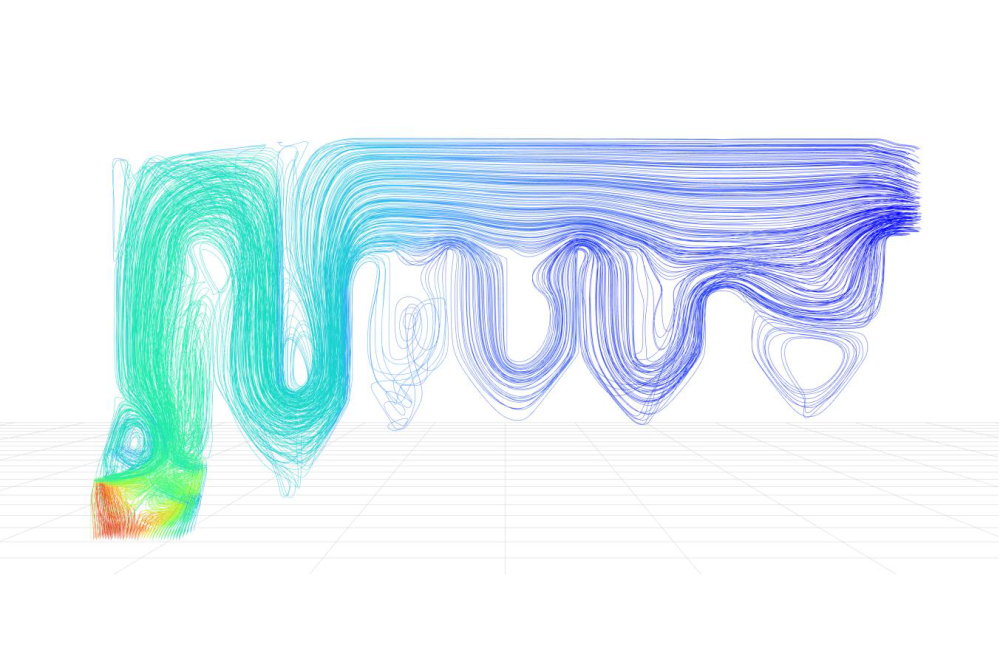
Figure 1: Particle path and velocity distribution(red: high velocity, blue: low velocity) of the exhaust gas.
Yannik LichtmanneggerIntroduction
The objective of the research project is to enhance the efficiency and reliability of waste incineration plants. The use of high-performance computing (HPC) enables the application of advanced simulation techniques, such as computational fluid dynamics (CFD), to model and comprehend the intricate dynamics of waste incineration processes. These novel methodologies facilitate the optimization of control systems within the plants, thereby ensuring a consistent energy output and enabling the compensation for fluctuations in renewable energies within the power grid. A principal objective of the project is a comprehensive examination of combustion processes and the composition of waste materials. Comprehensive measurement campaigns are employed to collect data, which is then incorporated into complex simulations. The simulations provide a visual representation of the temperature curves and chemical compositions of the flue gas within the plant. For instance, an optical camera was positioned above the waste hopper with the objective of monitoring the volume flow of waste into the plant. The data obtained is incorporated into dynamic process models that simulate the behavior of waste incineration plants under various conditions. The objective is to develop an enhanced control system that mitigates thermal fluctuations, enhances load stability and flexibility, and concurrently minimizes pollutant emissions. An extended monitoring system is employed to facilitate the early detection of faults and to optimize process control. Ultimately, this research should facilitate the continuous and reliable generation of electricity and heat from waste incineration plants. This results in a more efficient and environmentally friendly utilization of resources, as the generation of energy from waste is stabilized and optimized. The project thus constitutes a significant contribution to the integration of waste incineration into a modern, sustainable energy system capable of responding to the challenges posed by fluctuating renewable energies.
Methods
The project is divided into two parts. The Technical University of Munich carries out a RANS simulation (Reynolds Averaged Navier-Stokes Simulation) of the combustion in the combustion bed. These simulation results serve as input for the RANS simulation of the combustion chamber above the bed, including the flue gas draft, which is calculated by the Technical University of Darmstadt with Ansys Fluent on the Lichtenberg cluster.
Results
At this juncture, it is conceivable that the waste incineration plant could be fully meshed and the solution methods selected in a manner that would result in a stable simulation with regard to flow and temperature. Furthermore, the impact of radiation energy on temperature development in the waste incineration plant was considered, as this has a notable influence on the overall process. In order to predict the material conversion in the plant, it is necessary to expand the reaction mechanisms and implement the elementary reactions, taking into account the chemical reactions and species involved.
Discussion
The temperature distribution in the waste incineration plant and the species occurring serve as the basis for predicting the tendency to fouling. When used in combination with a discrete element method (DEM), these factors can be employed to predict corrosion in the waste incineration plant, thereby making an important contribution to efficient utilization. The combination of the combustion chamber simulation results from the Technical University of Munich with the model from the Technical University of Darmstadt offers a holistic view of a waste incineration plant.