
WoTan - Hydrogen Combustion for Aero-Engines: Study of Differential Diffusion on Multi-Regime Burner
 Isaac Farias _WoTan - Hydrogen combustion for aero-engines. Study of differential diffusion on multi-regime burner_Fig1
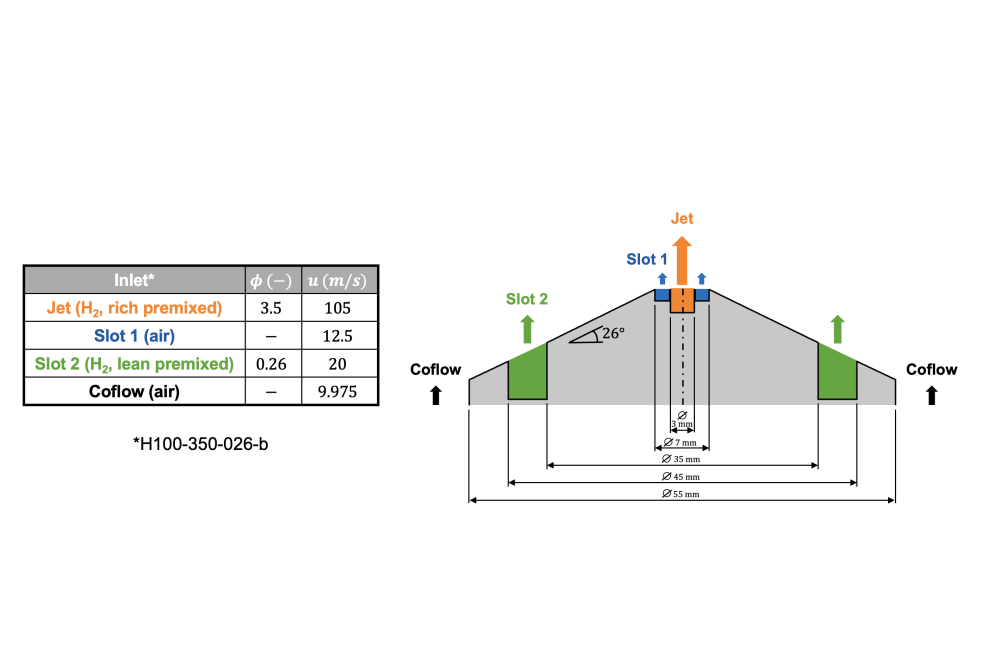
Figure 1: Sketch of multi-regime burner geometry as well as inlet conditions for simulated case H100-350-026-b.
 Isaac Farias _WoTan - Hydrogen combustion for aero-engines. Study of differential diffusion on multi-regime burner_Fig2
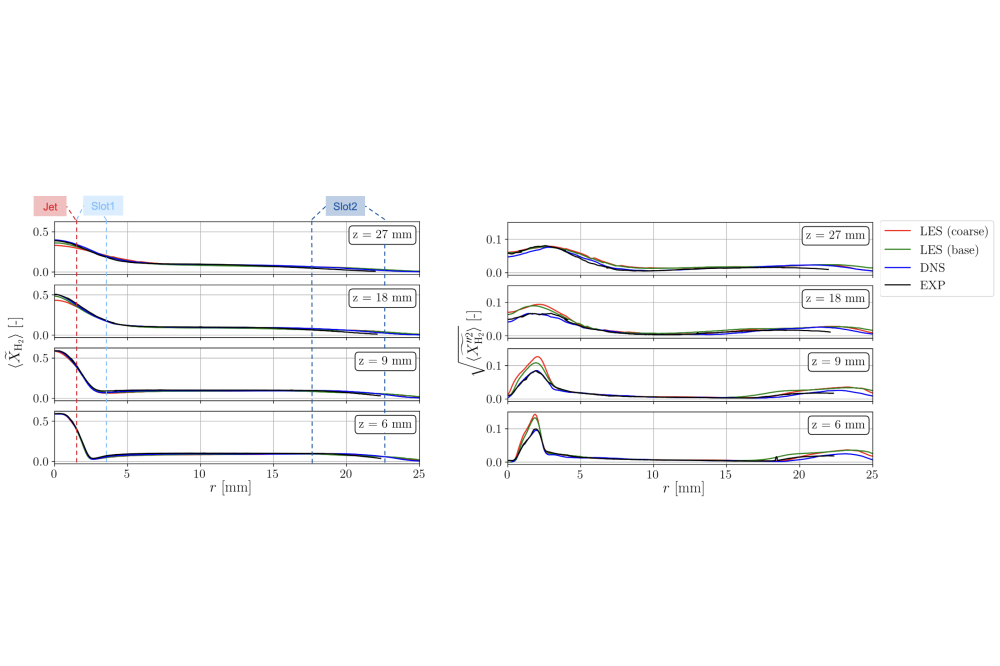
Figure 2: Radial plots of time-average (left) and root-mean-square fluctuation (right) of hydrogen mole fraction on different heights above the burner tip.
 Isaac Farias _WoTan - Hydrogen combustion for aero-engines. Study of differential diffusion on multi-regime burner_Fig4
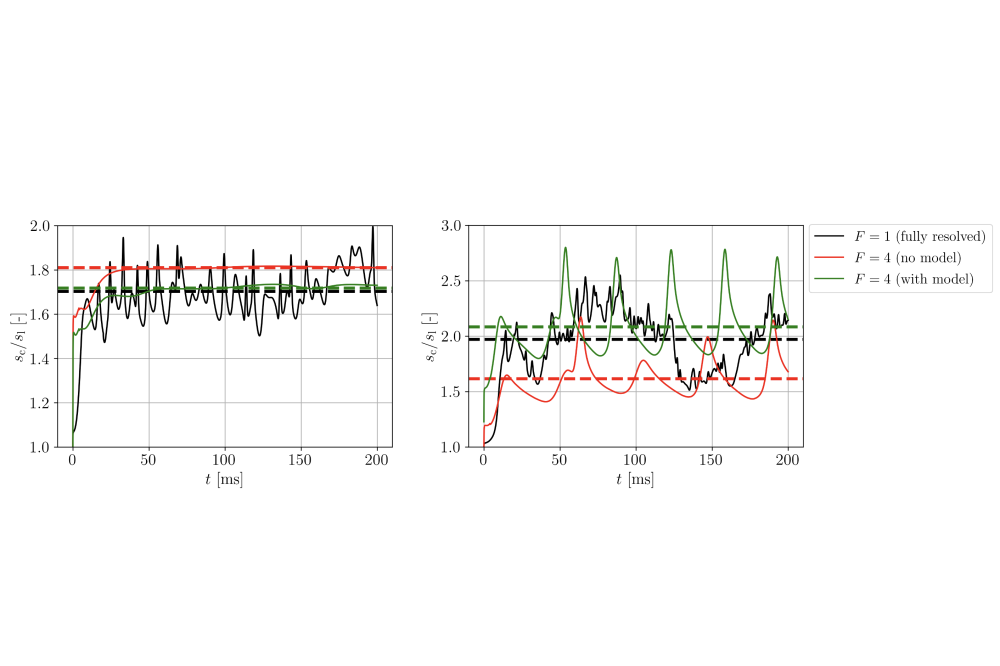
Figure 3: Consumption speed of 2D laminar flame, normalized with 1D freely-propagating value and plotted against simulation time for lateral domain sizes of 16 flame thicknesses (left) and 32 flame thicknesses.
 Isaac Farias _WoTan - Hydrogen combustion for aero-engines. Study of differential diffusion on multi-regime burner_Fig4
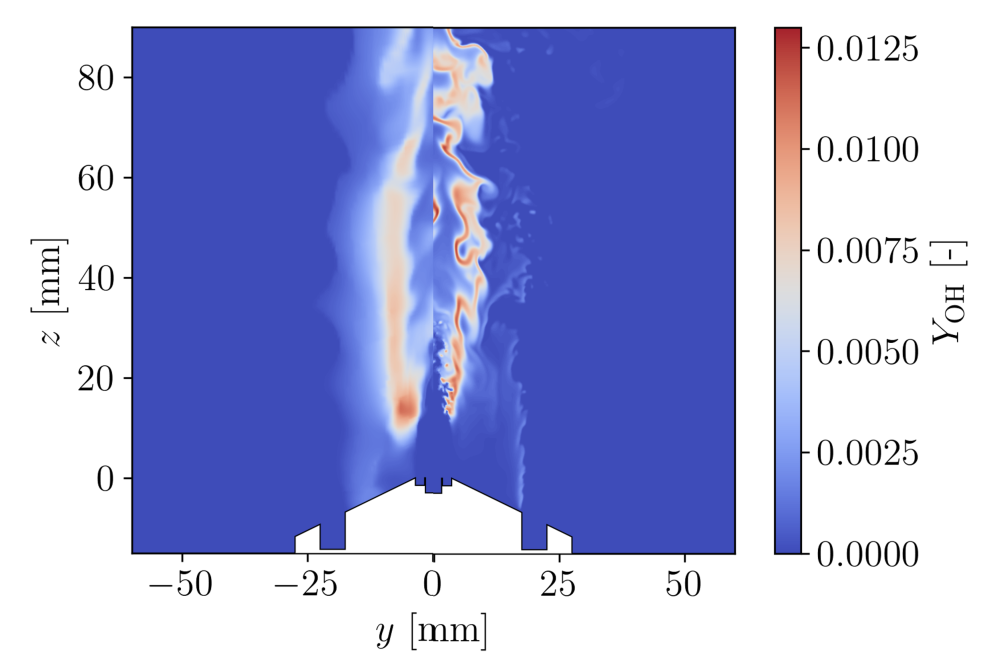
Figure 4: Comparison of instantaneous OH mass fraction of coarse LES (1.25M cells, left) and DNS (right).
Einleitung
Hydrogen is regarded as a key technology for achieving climate-neutral aviation and current efforts include developing combustor concepts based on the widely-used Rich-Quench-Lean (RQL) architecture. However, numerical combustion models commonly used for hydrocarbon fuels to improve aero-engine design fall short in accurately predicting hydrogen combustion. In particular, thermo-diffusive instabilities (TDI) - occurring in lean hydrogen combustion due to differential diffusion and capable of increasing flame speed by up to a factor of four - could not be accounted for by state-of-the-art modeling approaches. Since RQL combustors exhibit a multitude of coupled phenomena such as turbulence-chemistry interaction or flame-wall interaction while chemical reaction and mixing of fuel and air occur simultaneously, development and validation of numerical combustion models using such a complex configuration is unfeasible. In this work, a simplified multi-regime burner (figure 1) is used where similar flame characteristics as in an RQL combustor are observed. Initially, non-reactive simulations of this burner were performed in order to evaluate the capabilities of Large-Eddy Simulation (LES) to predict turbulent mixing, which is essential for the multi-regime configuration. Afterwards, an extension to the Artificially Thickened Flame (ATF) model was implemented into the Rolls-Royce in-house CFD solver PRECISE-UNS, validated in a 2D laminar setup and applied to the reactive multi-regime burner.
Methoden
All studies performed during this project used a finite-volume method for the simulation of the reacting flow field. For the 2D laminar cases, quasi-direct numerical simulations (DNS) were performed as a reference case where all flow phenomena are resolved. For validation of the ATF model - employed for turbulence-chemistry interaction and in order to account for sub-grid wrinkling due to thermo-diffusive instabilities - the same case was run with lower mesh resolution using LES, which was also used for all multi-regime burner studies. A detailed chemistry model was used for all simulations as well as a constant Lewis number diffusion model to account for preferential and differential diffusion in the context of hydrogen combustion.
Ergebnisse
Considering reactive simulations, a 2D laminar case at ambient conditions and an equivalence ratio of 0.4 was used to validate the implemented ATF model extension for thermo-diffusively unstable hydrogen flames. Since the lateral domain size constrains the wrinkled and finger-like structures evolving at these operating conditions, simulations of two different domain sizes were conducted. For both domains, a quasi-DNS was performed and regarded as the ground truth. Subsequently, the mesh resolution was reduced by a factor of four and accordingly, a thickening factor of four was applied to achieve the same resolution of the flame as in the fully resolved case. Since flame wrinkling and TDI structures scale with the thickening factor, flame speeds of the thickened cases without the ATF model extension did not match the respective fully resolved case. Figure 3 shows that activating the model extension recovered the correct flame speed, which proved the implementation was working properly.
Diskussion
The non-reactive multi-regime burner simulations showed promising results in terms of LES capturing turbulent mixing of hydrogen and air. This was an important preliminary study which proved that the high mass-diffusivity of hydrogen and the complex mixing process in a multi-regime configuration can be sufficiently captured. Subsequently, the ATF model for thermo-diffusively unstable hydrogen flames was successfully implemented into PRECISE-UNS and validated in a well-defined 2D laminar case. Having ensured validity and reliability of the model in this simplified case, it could be applied to the reactive multi-regime burner. Future work is needed to appropriately investigate microscopic and macroscopic flame structure as well as to run simulations on refined meshes in order to evaluate the influence of the decreasing sub-grid portion which has to be modeled.