
Influence of Mixing Characteristics on Polymerization Reactors
 Alexander Keßler_Influence of Mixing Characteristics on Polymerization ReactorsII_fig 1
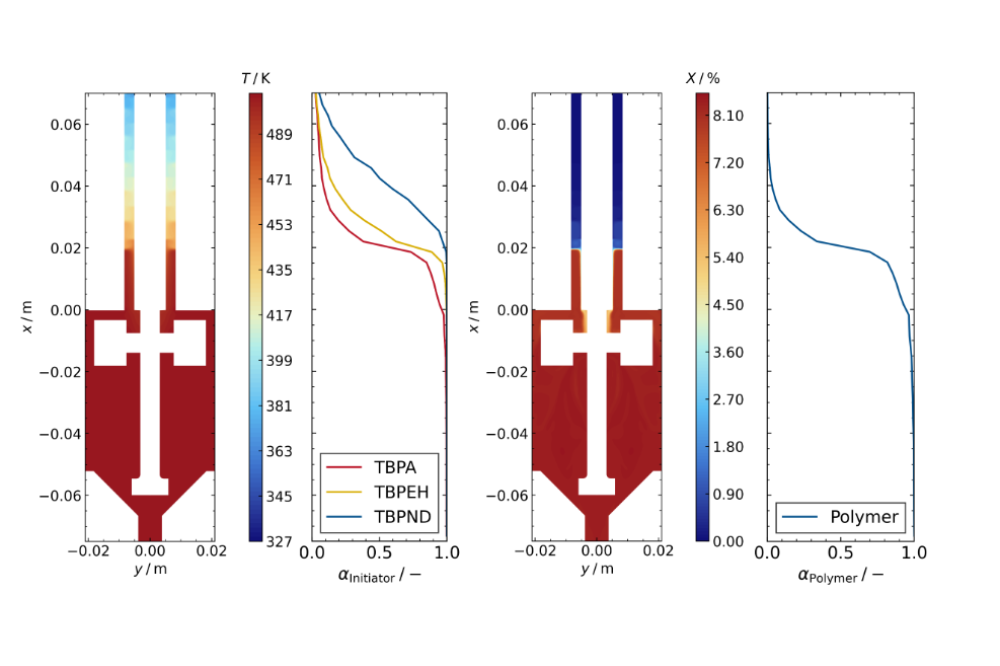
Figure 1: CFD simulation results for the original reactor geometry before any geometric modification. From left to right, the figure shows the temperature distribution T , the normalized decomposed initiator fraction αInitiator of TBPA, TBPEH, and TBPND along the x-position, the spatial distribution of monomer conver- sion X and the normalized polymer fraction αPolymer along the x-position. The results show a pronounced temperature increase in the region between stirrer shaft and stirrer lens, where the initiators decompose almost completely before reaching the main reaction chamber. In addition, polymer formed in the reactor chamber is transported back toward the inlet region.
 Alexander Keßler_Influence of Mixing Characteristics on Polymerization ReactorsII_fig 2
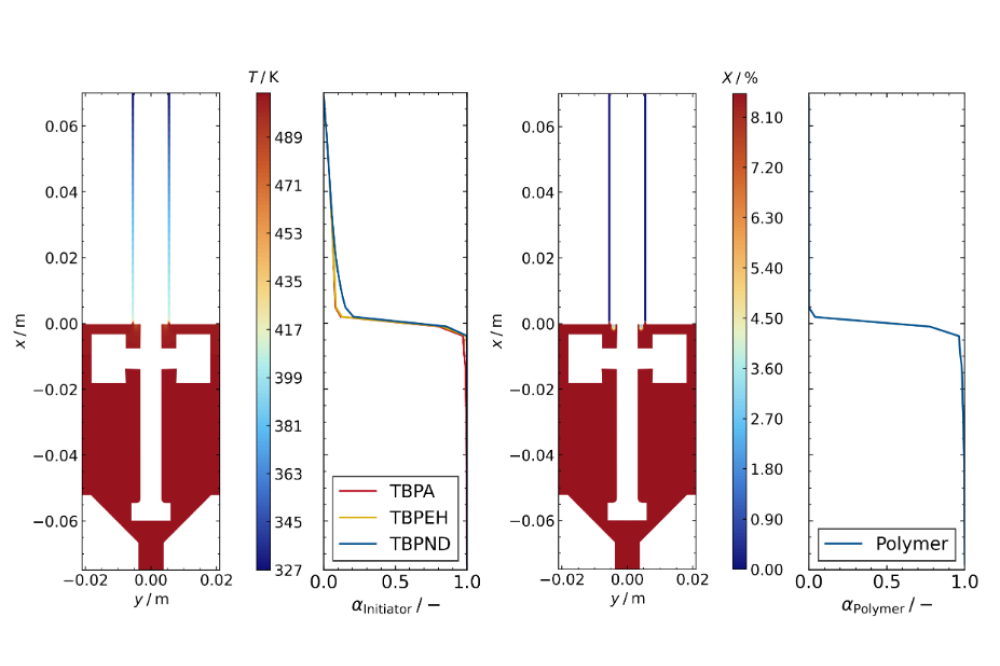
Figure 2: CFD simulation results for the modified reactor geometry with the redesigned stirrer lens. From left to right, the figure shows the temperature distribution T , the normalized decomposed initiator fraction αInitiator of TBPA, TBPEH, and TBPND along the x-position, the spatial distribution of monomer con- version X, and the normalized polymer fraction αPolymer along the x-position. Compared to the original geometry, the redesigned stirrer lens strongly sup- presses back-mixing from the reaction chamber toward the inlet region. As a result, the temperature increase between the stirrer shaft and the stirrer lens is reduced, initiator decomposition is shifted into the reactor chamber and polymer is no longer transported back toward the inlet region.
Einleitung
Low-density polyethylene (LDPE) is an important material in the global plastics market and is produced by the free-radical high-pressure polymerization of ethene. To improve the adhesion properties of LDPE, acrylic acid can be used as a comonomer. Acrylic acid introduces polar carboxylic acid groups into the otherwise nonpolar polyethylene backbone. Transferring this process to laboratory-scale autoclaves is challenging. The polymer formed during polymerization dissolves in supercritical ethene and increases the viscos- ity of the reaction mixture. At the same time, the polymerization releases large amounts of heat. Efficient heat removal is therefore essential, because an increase in temperature accelerates the reaction rate and can and lead to ethene decomposition. In addition, real autoclaves are not ideally mixed. As a result, concentration and temperature gradients can occur, and unfavorable mixing phenomena such as short-circuiting, back-mixing, and dead zones should be avoided. Recently, the 75 mL corrosion-resistant high-pressure au- toclave showed operating instabilities that resulted in decomposition events. The aim of this work was therefore to identify the causes of these instabilities. A High Performance Computer (HPC) was required because the investigation involved three-dimensional reactive computational fluid dynamics (CFD) simulations. These cal- culations are computationally demanding and enable the spatially resolved analysis of velocity fields, residence time distributions, concentration and temperature gradients, which cannot be obtained from ideal-mixed reactor models. This work provides a CFD- guided basis for future reactor redesign and for defining more stable experimental con- ditions in the 75 mL corrosion-resistant high-pressure autoclave.
Methoden
The reaction network of high-pressure copolymerization is integrated into ANSYS Fluent. The kinetics of the free-radical polymerization were implemented through Fluent’s user-defined functions (UDFs) using a C/C++ programmable interface. The kinetics of free-radical polymerization are implemented using the method of moments, account- ing for peroxide initiation, propagation, termination, and transfer reactions to low- and high-molar-mass species. Thermophysical properties such as density, viscosity, heat ca- pacity, and thermal conductivity were included as functions of mixture composition, temperature and pressure. The real geometry of the 75 mL corrosion-resistant autoclave was represented by a computational mesh and the stirrer motion was modeled using a single reference frame approach. Boundary conditions were taken from a laboratory experiment and used to define the inlet temperature, wall temperature and inlet com- position. This allowed the simulation to reproduce the relevant experimental conditions.
Ergebnisse
The simulated velocity field revealed several relevant flow phenomena. The reaction chamber itself was well mixed, but strong back-mixing occurred from the reactor body toward the inlet region. In addition, Taylor vortices formed in the gap between the stirrer shaft and the stirrer lens. The back-mixing caused a strong temperature increase in the region between the stirrer shaft and the stirrer lens, as shown in Figure 1. As a re- sult, the peroxide initiators decomposed almost completely before reaching the reaction chamber. The simulations also showed that polymer formed in the reaction chamber was transported back toward the inlet region. This is unfavorable because the temperature decreases strongly toward the inlet and fall below the cloud point of the mixture. Under these conditions, phase separation may occur, causing polymer to deposit in this region. Therefore, several geometric modifications were investigated to reduce or eliminate the back-mixing. These included a throttle at the stirrer shaft, a redesigned stirrer lens, and a trap-like geometry. Among these options, the redesigned stirrer lens showed the best performance in suppressing back-mixing, as shown in Figure 2. Eliminating the back-mixing reduced the temperature in the region between the stirrer lens and the stirrer shaft. Consequently, most of the initiator decomposition was shifted into the main reaction chamber, where the polymerization is intended to take place. In addition, polymer was no longer transported from the reaction chamber toward the inlet. Further simulations showed that increasing the ethene inlet flow and decreasing the stirrer speed also reduced the intensity of back-mixing.
Diskussion
Based on the CFD results, a new stirrer lens will be constructed to significantly reduce back-mixing in future laboratory experiments. As a next step, a PMMA replica of the 75 mL corrosion-resistant autoclave will be built. This transparent model will be used for residence time experiments and flow visualization. The aim is to observe the flow phe- nomena predicted by the CFD simulations experimentally and to compare the measured residence time behavior with the simulation results. This will allow the CFD model to be validated.