
Modelling of Local Failure Mechanisms and Macroscopic Strength Properties of HyPo (Hybrid Porous)-Materials
 Alexander Schülter_Modelling of Local Failure Mechanisms and Macroscopic Strength Properties of HyPo (Hybrid Porous)-Materials
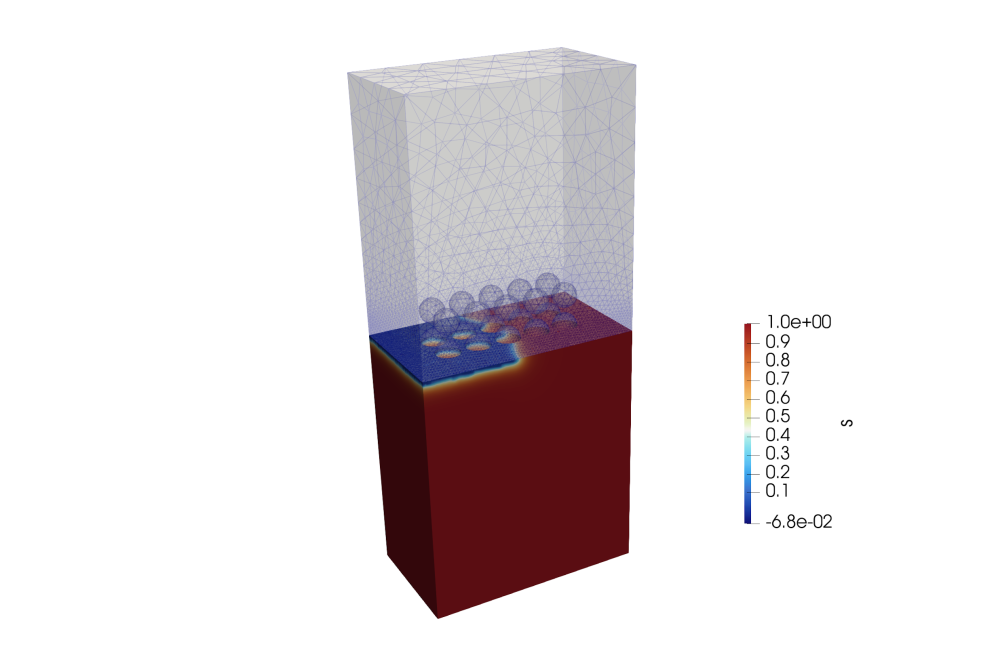
(Left) Evolution of the phase field indication fracture and (Right) evolution of the internal variable α describing plastic deformation in a numerical experiment.
Einleitung
Hybrid porous materials combine different metallic phases with an intentionally designed pore structure. This combination allows the creation of lightweight components with tailored mechanical and functional properties. Such materials are highly attractive for modern engineering applications because they can combine strength, weight reduction, and additional functions such as thermal or electrical behavior within a single component. However, their complex internal structure makes their mechanical behavior difficult to predict. Local stress concentrations around pores and material interfaces may lead to crack initiation and ultimately to failure. Understanding how microscopic damage mechanisms influence the overall strength of a component is therefore essential for safe and efficient design. Experimental investigations alone are not sufficient to resolve these microscopic processes in three dimensions. High-resolution simulations are required to analyze real microstructures and to follow crack initiation and propagation inside the material. These simulations involve millions of unknowns and strongly nonlinear behavior. For this reason, High Performance Computing is indispensable for the project.
Methoden
The project is based on microstructure-resolved numerical simulations. Three-dimensional material models are generated from high-resolution computer tomography scans of real hybrid porous materials. The image data are processed and converted into finite element meshes that accurately represent pores and different material phases. On these meshes, mechanical simulations are performed to determine stress distributions and local deformation behavior. In a second step, a fracture model is incorporated that allows cracks to initiate, grow, stop, and branch naturally within the material. This approach represents cracks as a smooth transition between intact and damaged material, which requires a very fine spatial resolution. Extensive parameter studies are carried out to investigate the influence of pore size, pore distribution, material contrast, graded properties, and nonlinear material behavior. The simulations are performed in parallel on a computing cluster using distributed memory processing. Each individual simulation may involve several million degrees of freedom and requires many processor cores running simultaneously.
Ergebnisse
During the reporting period, a complete simulation workflow has been established. Real microstructures of metallic foams were reconstructed from tomography data and converted into three-dimensional numerical models. Elastic simulations were performed to determine effective stiffness properties. The numerical predictions showed very good agreement with experimental measurements and confirmed the reliability of the modeling approach. In a second phase, the fracture model was implemented and applied to porous microstructures. The simulations revealed that crack re-initiation at pore surfaces plays a dominant role in determining the overall crack resistance. The geometry of the pores was found to strongly influence fracture behavior. Rounded pores led to higher effective crack resistance than sharp-edged pores. The model was further extended to include nonlinear material behavior. These simulations demonstrated that ductile deformation mechanisms can significantly increase the effective crack resistance of porous materials. Overall, the results show that microstructural design has a strong and sometimes counterintuitive impact on macroscopic strength.
Diskussion
The results demonstrate that microscopic mechanisms such as local stress concentration, crack re-initiation, and material nonlinearity strongly influence the overall strength of hybrid porous materials. Importantly, the simulations show that porosity does not automatically weaken a material. Under certain conditions, the interaction between pores and crack growth can increase effective crack resistance. The project also highlights the necessity of High Performance Computing. Accurate fracture simulations require very fine spatial resolution in three dimensions. Because cracks are represented as diffuse transition zones, several computational elements are needed across each damage region. This leads to models with millions of unknowns. In addition, extensive parameter studies are required to identify systematic trends. A single simulation can run for many hours on hundreds of processor cores. Without parallel computing on a high-performance cluster, these studies would not be feasible. In the next phase, the focus will shift toward graded materials and multifunctional behavior, including thermal and electrical effects. These extensions will further increase computational complexity. The developed tools will contribute to improved design strategies for lightweight multifunctional components and will strengthen the predictive understanding of hybrid porous materials.