
Numerical Investigation of Methanol Port Fuel Injection for Maritime Applications and Its Subsequent Effects on Mixture Formation
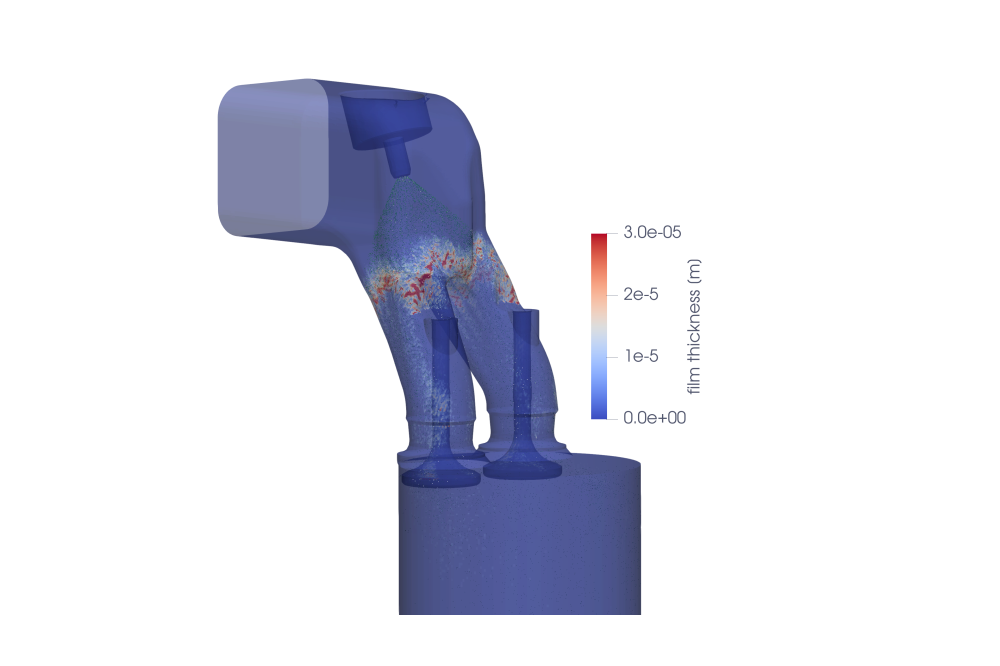 Jannis Reusch_IL_Numerical Investigation of Methanol Port Fuel Injection for Maritime Applications and Its Subsequent Effects on Mixture Formation_Fig1
Lagrangian methanol spray interacting with the intake port walls of the engine flow bench, forming an Eulerian wall film.
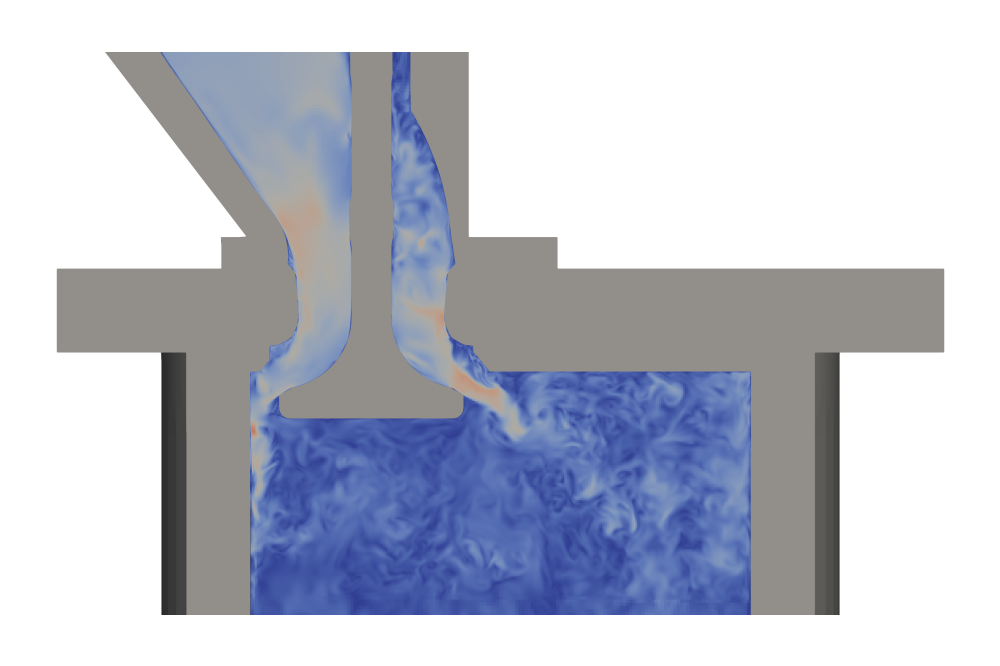 Jannis Reusch_IL_Numerical Investigation of Methanol Port Fuel Injection for Maritime Applications and Its Subsequent Effects on Mixture Formation_Fig2
Instantaneous velocity magnitude field and solid domain from a multi region Large Eddy Simulation (LES) of the engine flow bench, highlighting turbulent flow structures of the intake-jet.
Einleitung
The maritime sector must significantly reduce greenhouse gas and pollutant emissions while maintaining reliable long-lifetime propulsion systems. Because fleet renewal is slow, retrofit solutions for existing engines are essential. E-methanol is a promising marine fuel due to its liquid storage at ambient conditions and potential for low net-CO₂ operation when produced renewably. A key challenge in methanol retrofits is mixture formation when using port fuel injection (PFI), as methanol’s high latent heat combined with low heating value can promote wall-films and inhomogeneous mixtures, leading to suboptimal combustion and reliability issues. A holistic, high-fidelity numerical simulation of a PFI engine flow bench is therefore required to understand the processes of spray dynamics, wall-film formation, mixture formation and heat transfer, including their interaction with turbulent flow structures. Such high-fidelity CFD is computationally intensive and relies on HPC resources.
Methoden
The project developed a 3D-CFD workflow in the open-source solver OpenFoam for methanol port fuel injection (PFI) which was validated based on an optically accessible engine flow bench. Turbulence was modeled using both RANS and LES. RANS was applied as the primary approach for robust turnaround and direct transfer to an industrial development workflow, while LES served as a higher-fidelity reference to assess the limitations of RANS in resolving unsteady intake turbulence and its impact on mixing. Spray dynamics for several methanol injector concepts were simulated with an Euler–Lagrange approach, tracking Lagrangian droplets in an Eulerian gas phase and accounting for spray–turbulence interaction, evaporation, and wall impingement. To represent wall-film formation and its impact on mixture formation, a multi-region solver was implemented, coupling gas, liquid film, and solid regions. This enabled modeling of film dynamics together with conjugate heat transfer, which is essential for predicting evaporation rates and the persistence of wall wetting. Post-processing and validation were performed with Python workflows. Spray predictions were compared to experimental spray imaging using the computed Projected Liquid Volume (PLV) as a consistent signal metric. The single-phase flow fields were validated against Particle Image Velocimetry (PIV) measurements, comparing mean velocities and turbulence-related quantities in the flow bench. While film dynamics were compared to Refractive Index Matching (RIM) and Laser Induced Florescence (LIF) measurements.
Ergebnisse
The project developed a 3D-CFD workflow in the open-source solver OpenFoam for methanol port fuel injection (PFI) which was validated based on an optically accessible engine flow bench. Turbulence was modeled using both RANS and LES. RANS was applied as the primary approach for robust turnaround and direct transfer to an industrial development workflow, while LES served as a higher-fidelity reference to assess the limitations of RANS in resolving unsteady intake turbulence and its impact on mixing. Spray dynamics for several methanol injector concepts were simulated with an Euler–Lagrange approach, tracking Lagrangian droplets in an Eulerian gas phase and accounting for spray–turbulence interaction, evaporation, and wall impingement. To represent wall-film formation and its impact on mixture formation, a multi-region solver was implemented, coupling gas, liquid film, and solid regions. This enabled modeling of film dynamics together with conjugate heat transfer, which is essential for predicting evaporation rates and the persistence of wall wetting. Post-processing and validation were performed with Python workflows. Spray predictions were compared to experimental spray imaging using the computed Projected Liquid Volume (PLV) as a consistent signal metric. The single-phase flow fields were validated against Particle Image Velocimetry (PIV) measurements, comparing mean velocities and turbulence-related quantities in the flow bench. While film dynamics were compared to Refractive Index Matching (RIM) and Laser Induced Florescence (LIF) measurements.
Diskussion
This study established a validated, high-fidelity simulation framework for methanol port fuel injection in large-engine intake systems. By combining RANS and LES with detailed spray, wall-film, and conjugate heat transfer modeling, the framework captures the key physical processes governing mixture formation, wall wetting, and evaporation. The close agreement with experimental spray, flow, and wall-temperature data demonstrates that the approach is suitable for predictive use rather than qualitative assessment only. The developed methodology provides a solid basis for systematic parameter studies in future methanol PFI developments, including injector design, targeting and operating conditions. In the longer term, the framework can be extended toward more engine-representative configurations and transferred into industrial workflows, supporting the design of robust retrofit solutions that reduce both greenhouse gas and pollutant emissions in maritime applications.