
Analysis of High Resolving DNS of H2 and NH3 Flames
 Felix Rong_Analysis of high resolving DNS of H2 and NH3 flames_Fig1
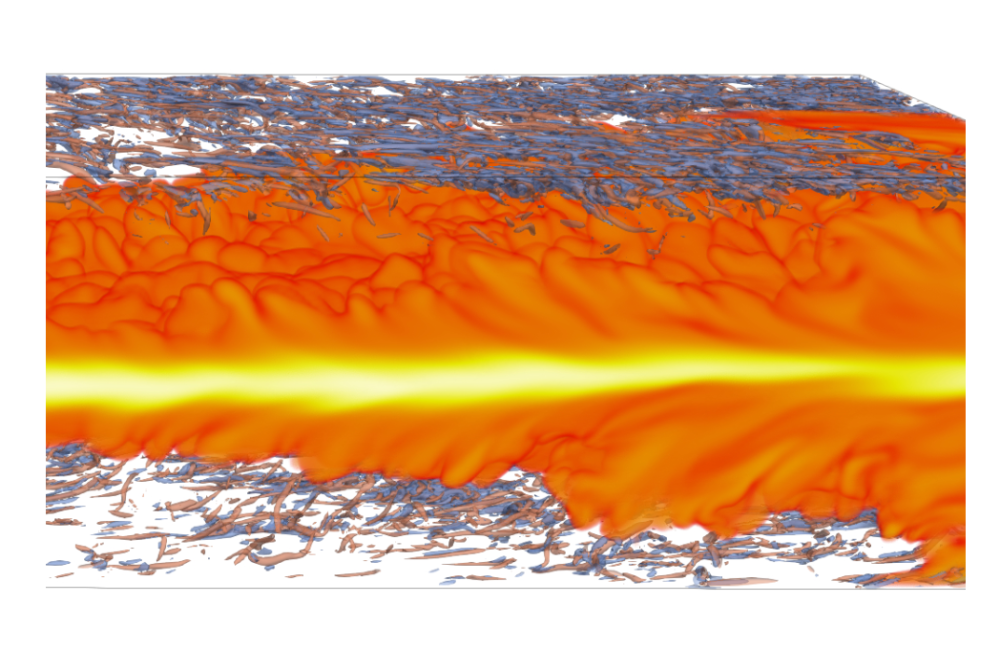
Figure 1: Instantaneous snapshot of a turbulent channel flow flame with a fuel-lean premixed hydrogen/air flame at conditions susceptible to thermo-diffusive phenomena. The flame by the three-dimensional rendered temperature field and turbulent structures are illustrated by the Q-criterion, with red and blue isosurfaces representing positive and negative iso-values, respectively.
 Felix Rong _Analysis of High Resolving DNS of H2 and NH3 Flames_Fig2
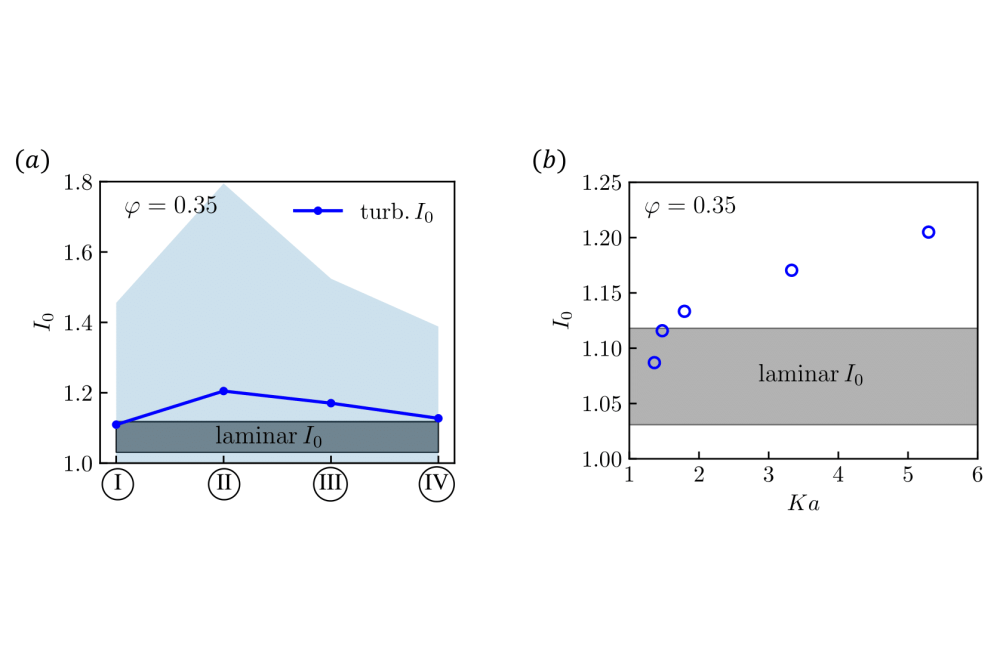
Figure 2: Averaged stretch factor I0 in bins I-IV corresponding to different wall-normal distances (a). The bin I corresponds to the near wall region, while bin IV is in the channel core. The blue corridor denotes one standard deviation. For reference, the range of I0 values for homologous laminar flames is marked by the gray shaded area. Local stretch factor I0 plotted against the local Karlovitz number (b).
Einleitung
The global shift toward sustainable energy systems has created an urgent need to develop clean and efficient alternatives to conventional fossil fuels. Hydrogen and ammonia have emerged as promising candidates because they can be produced with low environmental impact and used without releasing carbon dioxide during combustion. However, their behavior during combustion is highly complex, especially under turbulent conditions that occur in practical applications such as gas turbines, engines, and industrial burners. Understanding these processes is essential for designing future low-emission energy systems.
Methoden
To investigate these combustion processes in detail, this project analyzes several large-scale Direct Numerical Simulation (DNS) datasets resolving all physical scales without relying on simplified models. These simulations resolve all turbulent motions down to the smallest scales, including the computation of chemical reactions with detailed chemical kinetics.The goal of the project is to analyze simulation data of turbulent hydrogen and ammonia flames to improve scientific understanding and to provide high-quality data for future research in combustion science. The project focuses on the systematic analysis of high-resolution simulation datasets. These datasets represent turbulent combustion processes under different operating conditions and configurations. The analysis includes spatial and temporal averaging to extract meaningful trends from the complex and rapidly changing fields. Additional conditional analyses allow the project to isolate specific physical phenomena by examining data only in regions of interest, such as flame fronts or highly turbulent areas. The work relies heavily on HPC infrastructure, not only for storing the datasets but alsoBfor processing them efficiently. The analysis scripts are mainly written in Python and make extensive use of parallel processing techniques to reduce computation times. The datasets are accessed and visualized through structured workflows that enable consistent and reproducible evaluation of very large volumes of information. In addition, the opensource software Paraview is used. Version control practices are applied throughout the project to ensure reproducibility and transparent collaboration. For additional reference simulations and validation cases, an in-house flame solver (C++) and the open-source solver OpenFOAM are used. During the project, the main focus was on setting up the analysis environment, organizing the data structure, and developing reliable workflows capable of handling these large DNS datasets. This included implementing robust scripts for reading, processing, and visualizing the simulation fields on HPC systems. Moreover, comprehensive analyses of the simulation data were conducted.
Ergebnisse
In turbulent combustion modeling and for accurate numerical prediction of combustion processes, the turbulent flame speed and the flame surface area are of fundamental interest. For turbulent combustion of conventional hydrocarbon fuels in air, where the effective Lewis number is close to unity, the first Damköhler hypothesis holds and the stretch factor remains near unity (I0 ∼ 1). In contrast, flames with effective Lewis numbers well below unity are susceptible to thermo-diffusive (TD) phenomena, which can substantially elevate local reactivity and burning rate. These localized enhancements accelerate the global flame front beyond what would be expected from surface-area wrinkling alone, leading to stretch-factor values that may exceed unity by several fold. In TD-susceptible premixed flames, the stretch factor provides a quantitative measure of their departure from the conventional behavior described by the first Damköhler hypothesis, and thus reflects the relative influence of TD effects on the burning rate. Several recent studies suggest that accurate prediction of the stretch factor is essential for reliably capturing the propagation characteristics of hydrogen flames affected by TD phenomena. Figure 2.a shows the stretch factor I0, together with one standard deviation, evaluated in bins I-IV as a function of wall-normal position. A clear increase in I0 is observed when moving from the core flow toward the wall, with both the mean and fluctuation levels reaching a pronounced peak in bin II, which aligns with the location of maximum turbulence intensity. For reference, the range of I0 values corresponding to the homologous laminar flames is indicated by the gray-shaded region, highlighting the substantial synergistic interaction between turbulence and TD phenomena. These combined effects strengthen with increasing turbulence intensity, leading to elevated stretch-factor values particularly in bins II and III. This behavior is particularly significant for practical applications, as it relates directly to the risk of boundary-layer flashback in hydrogen-fired combustors. Importantly, the present DNS analysis establishes a quantitative correlation between the local Karlovitz number, defined by the blue dots in figure 2.b, and the local stretch factor I0, shown in the figure in a shear-driven, wall-bounded turbulent channel flow flame. At relatively low Karlovitz numbers (Ka ∼ 1–2), I0 rises steeply, exceeding its laminar counterpart for Ka = 1.8. At elevated Karlovitz numbers (Ka ∼ 2–6), the increase in I0 becomes more gradual and approaches a linear trend. These analyses provided new insights into how hydrogen and ammonia behave under turbulent combustion conditions. The findings contributed to a conference presentation at the European Combustion Meeting (ECM). Key outcomes of this project include the successful training and mentoring of students, the presentation of the work at an international conference, and the establishment of collaborations with international researchers. Most importantly, the project advanced the theoretical and fundamental understanding of flame physics and laid the foundation for a peer-reviewed publication that is currently under review.
Diskussion
The results demonstrate the value of using high-resolution numerical simulations to gain a deeper understanding of hydrogen and ammonia combustion, relevant for future energy and propulsion systems. The possibility offered by DNS to examine physical processes in full detail enables the identification of mechanisms that are difficult or impossible to observe in experiments. The findings not only contribute to ongoing scientific discussions but also support the development of more accurate predictive tools for designing future combustion systems. The project also highlights the essential role of HPC resources. Without large storage and memory capacities and parallel computing capabilities, it would not have been possible to analyze the datasets efficiently or generate results suitable for scientific publications. Looking forward, the project will finalize the submission for a journal publication and explore new physical questions. There are plans to publish parts of the dataset and example analysis scripts to support the broader scientific community.