
Numerical Design Study of a Combustion Chamber Simulator
 Marvin Lücke_Numerical Design Study of a Combustion Chamber Simulator_Figure1
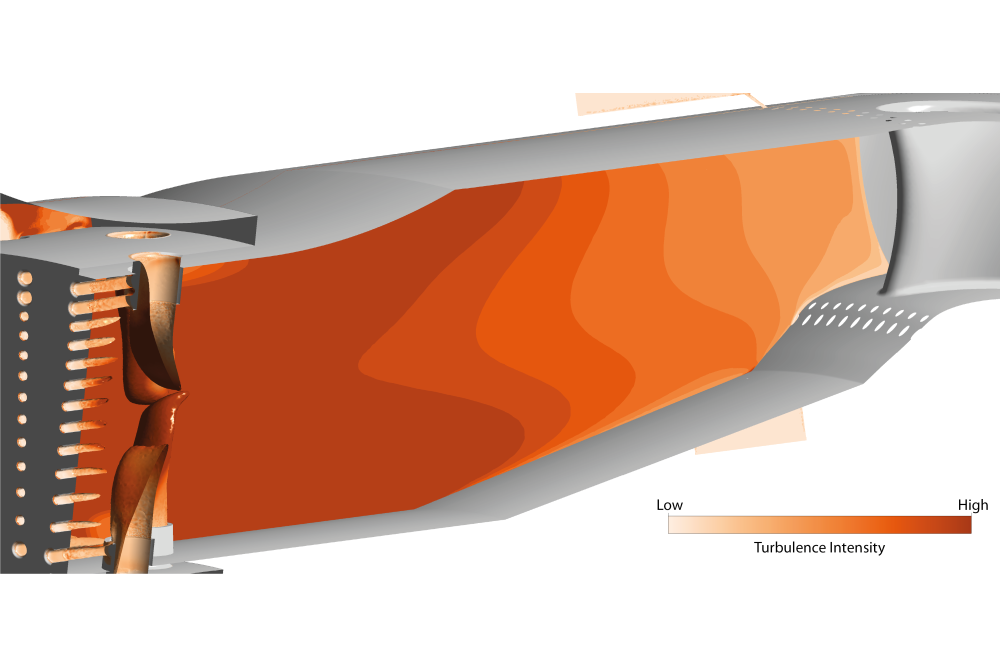
Figure 1: Development of Turbulence Intensity downstream of a Combustion Chamber Simulator.
Marvin LückeEinleitung
In order to investigate the influence of high combustion chamber turbulence resulting from future combustion concepts (e.g. lean combustion, hydrogen combustion) on the high pressure turbine in a jet engine or gas turbine, a variable combustion chamber simulator will be designed for the Large Scale Turbine Rig (LSTR), a 1,5-stage, low speed, Reynolds number similar turbine test bench at the institute of Gas Turbines and Aerospace Propulsion of TU Darmstadt. To ensure the variability of the design, the combustion chamber simulator components are exchangeable. Due to the complex, highly turbulent and instationary flow resulting from the setup, numerical investigations utilizing RANS and uRANS simulations are necessary to finalize the design of the components. The numerical domain’s extent favors the use of a
high performance computing cluster in order to profit from computing time reduction by parallelization during the computations.
Methoden
The preparation of the numerical simulations comprised the derivation of the various combustion chamber simulator designs with a plentitude of inlet plate and mixing port variations and combinations. Prior to the final simulations, a mesh study was conducted in order to ensure the independency of the numerical solutions from the numerical grid. Special attention was paid to the zones of turbulence generation, i.e. the areas of jet impingement
and jet-in-crossflow. After finalizing the meshes, RANS simulations were performed. Due to the highly instationary flow behavior, convergence could not be achieved with RANS simulations alone, why uRANS simulations became necessary. A timestep study was conducted for the challenging definition of a timestep size for the uRANS simulations due to the presence of a wide range of velocities (Mach number between 0.02 and 0.3) in a large domain of more than 1.5m in length with geometric features resolved in the sub-millimeter scale.
Ergebnisse
The numerical simulations gave insights into the generation and behavior of turbulence throughout the combustion chamber simulator with various geometries. It was verified, that the presence of the combustion chamber simulator only negligibly impacts other flow parameters such as flow velocities, angles and pressure distribution. Turbulence intensities in a range from 2% to 25% are predicted for the different designs, which meets the design intent. Depending on the desired turbulence intensity, different turbulence generation mechanisms are dominant. While low turbulence intensities are achieved using grid turbulence, higher turbulence intensities necessitate jet-in-crossflow interaction or jet impingement. Furthermore, higher turbulence cases also depict a change in turbulent length scales, anisotropy and pressure losses, which might be mainly attributable to a larger amount of massflow passing through the large diameter mixing ports. The numerical domain contained the test bench’s first stator row domain including its cooling features. This enables the analysis of the migration of turbulence across the first stator section and it’s influence on the losses and cooling flows in the stator domain. In combination with future experimental results, this will give detailed insights into the stator flow under the influence of various levels of turbulence. While detailed investigations are still ongoing, a 30% increase in total pressure loss could be observed.
Diskussion
In total, the numerical results approve a promising potential of the combustion chamber simulator. Combustion chamber simulator configurations generating a wide range of turbulence intensities have been designed and simulated. However, the performed simulations still struggle to fully converge and are therefore still unable to fully resolve the flow state. Following this study, scale resolving simulations will be applied to achieve this. A basic configuration of the combustion chamber simulator is finalized based on the obtained results and integrated into a component test wind tunnel for further validation of the numerically investigated configurations.