
Metallic Glass Relaxation: Long Time Dynamics and Delution Response
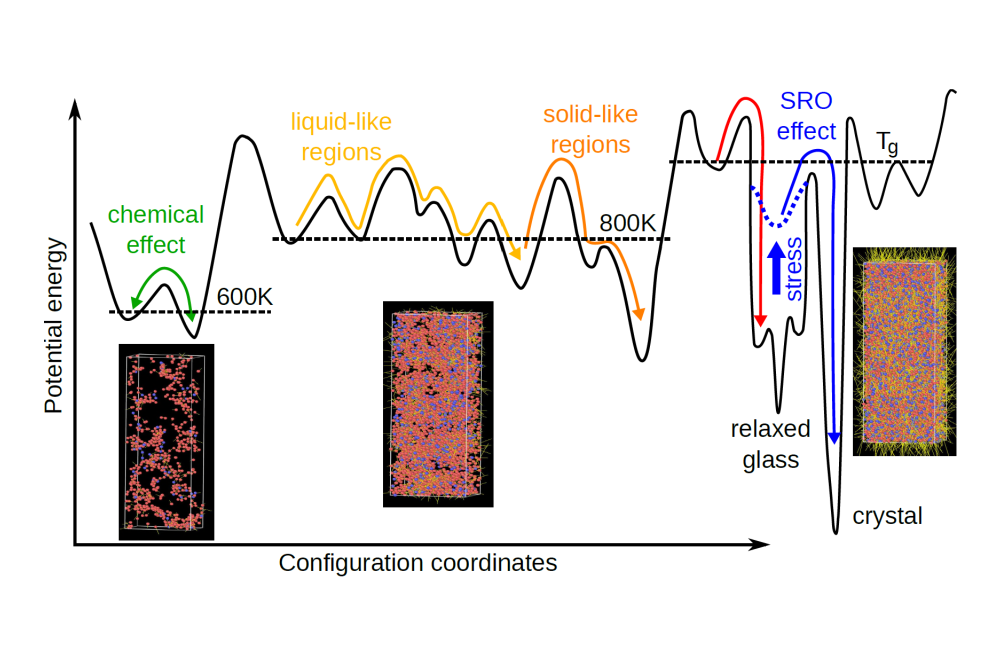 Daniel Sopu_Metallic Glass Relaxation: Long Time Dynamics and Delution Response_Figure1
Figure 1: A schematic representation of the three relaxation stages in the potential energy landscape. The three panels show those atoms with displacements > 0.2 nm together with their displacement vectors.
Einleitung
Metallic glasses are solids with a disordered atomic structure, giving them unique mechanical and dynamic properties. Understanding their behavior is challenging because their structure and deformation processes occur over wide time and length scales, often beyond experimental reach. This project uses computer simulations to explore how atomic structure changes under extend microsecond Molecular Dynamics (MD) simulations. Such simulations requires extended timescales reaching the microsecond range while tracking extremely fast events and demanding significant computational power. High Performance Computing (HPC) enables these large-scale, detailed simulations, making it possible to uncover fundamental mechanisms that link atomic motion to the remarkable properties of metallic glasses.
Methoden
We used large-scale computer simulations to investigate how atoms in metallic glasses moved, relaxed, and rejuvenated under different thermal and mechanical conditions. MD was employed to model atomic motion over extended timescales reaching the microsecond range, enabling the observation of both fast and slow relaxation events. The simulations were performed using the LAMMPS software, which efficiently distributed computational tasks across many processors on high-performance computing systems. To explore the effect of structural heterogeneity, a dilution method was applied by selectively removing a small fraction of atoms from specific regions of the sample. This approach allowed us to create controlled free-volume variations and study how such structural modifications influenced relaxation dynamics and rejuvenation behavior. Atomic configurations and deformation processes were analyzed using OVITO, where atomic displacements, local stresses, and short-range structural motifs were visualized and quantified through custom Python scripts. Together, these methods enabled us to reveal the atomic-scale mechanisms responsible for structural relaxation, rejuvenation, and stability in metallic glasses. The combination of long-timescale simulations, controlled structural manipulation, and advanced data analysis provided critical insights into how atomic rearrangements govern the macroscopic mechanical response of these complex materials.
Ergebnisse
This project focused on understanding the relaxation and rejuvenation behavior of metallic glasses through atomistic simulations. Due to the inherent limitations of computational capacity, simulations were restricted to nanoscale systems and microsecond timescales, capturing local atomic rearrangements but not larger-scale processes. The initial studies on CuZr glasses revealed distinct relaxation mechanisms, with atomic motion strongly dependent on temperature and composition. In the first sub-project, simulations with 8,000 atoms provided insight into localized relaxation, but now larger systems of 48,000 atoms were used to capture extended string-like atomic movements and structural heterogeneity. The systems were heated between 100 K and 1200 K and relaxed for at least one microsecond at each temperature. The second sub-project investigated relaxation below and near the glass transition temperature. At lower temperatures, relaxation was dominated by light-atom motion, while near the transition temperature more than half of the atoms participated in structural rearrangement. Long simulations, extending beyond ten microseconds, were proposed to capture slower dynamic modes and correlate relaxation with residual stress accumulation. Finally, in the third sub-project, new interatomic potentials were tested for multicomponent alloys such as CuZrAl and high-entropy FeCoCrNiAl₀ glasses. These systems exhibited more complex relaxation behavior, offering valuable insight into how compositional complexity influences atomic dynamics and stability.
Diskussion
The simulations provided valuable insights into the atomic-scale relaxation behavior of metallic glasses, revealing how temperature, composition, and structural complexity influence their dynamics. For the CuZr system, the results confirmed that atomic motion remains highly localized at low temperatures but becomes collective near the glass transition, where more than half of the atoms participate in relaxation. The limited system size, however, restricted the observation of large-scale cooperative motions that may occur in real materials. Increasing the system size and extending the simulation time are therefore essential to capture such phenomena. The investigations of multicomponent alloys, including CuZrAl and the high-entropy FeCoCrNiAl system, showed that additional elements significantly increase the complexity of relaxation processes. These alloys exhibited richer dynamic behavior, suggesting that chemical diversity enhances local heterogeneity and may improve mechanical stability. Future work will focus on extending the simulations to larger systems (> 48000 atoms) and longer timescales (up to 10) to bridge the gap between atomic and experimental observations. The use of more efficient interatomic potentials will enable the study of multi-component metallic glasses with greater accuracy. Ultimately, these efforts aim to uncover universal relaxation mechanisms and provide design guidelines for next-generation metallic glasses with improved ductility, strength, and thermal stability.